Skip to Main Content
Data Science

Machine Learning for Quota Setting: When It Works and When It Doesn't

Key Takeaways to Get Started

  • Assess predictability and organizational readiness to decide whether machine learning should inform, support or lead.
  • Define the quota-setting process, including where machine learning enters, how outputs are governed and how guardrails apply.
  • Build and validate the model on relevant data so its recommendations stay credible and explainable.
  • Plan for change management and downstream effects, starting with compensation.

Data-Driven Quotas Build Trust, But Only When Predictability and Organizational Readiness Line Up

Quota setting runs on credibility. When targets feel arbitrary, reps disengage and leaders lose the buy-in that makes a number hold. With comprehensive data becoming more readily available, sales teams have a wealth of information to use in the quota-setting process—yet most aren’t taking advantage of it. This credibility challenge is driving greater interest in machine learning (ML) as a tool for building more accurate and credible quotas. ML offers a fix by providing quotas grounded in data instead of instinct. However, an organization must already be prepared to use this new resource. If applied in the wrong environment, ML feels like a black box that erodes the trust it was meant to build.

Close

Where Traditional Quota Setting Loses Credibility

Traditional quota setting carries three problems. Broad growth assumptions ignore real differences in market and territory opportunity. Revenue outcomes vary widely with pricing, product mix, coverage and sales motion. And when sellers see targets as inequitable, they lose trust, motivation and confidence in the goal.

Machine learning addresses each one. It uses fact-based account and territory differentiation to set fair, defensible quotas. It replaces instinct with transparent, evidence-based assumptions, which builds confidence in top-down targets. And it applies a repeatable, scalable method that reduces reliance on judgment calls.

The through-line is simple. Machine learning uses real numbers to make the call, so leaders can defend their decisions with specific, comprehensive evidence behind them. However, these benefits are only seen under the right conditions for organizations that are prepared to receive them.

When Machine Learning Earns Its Place

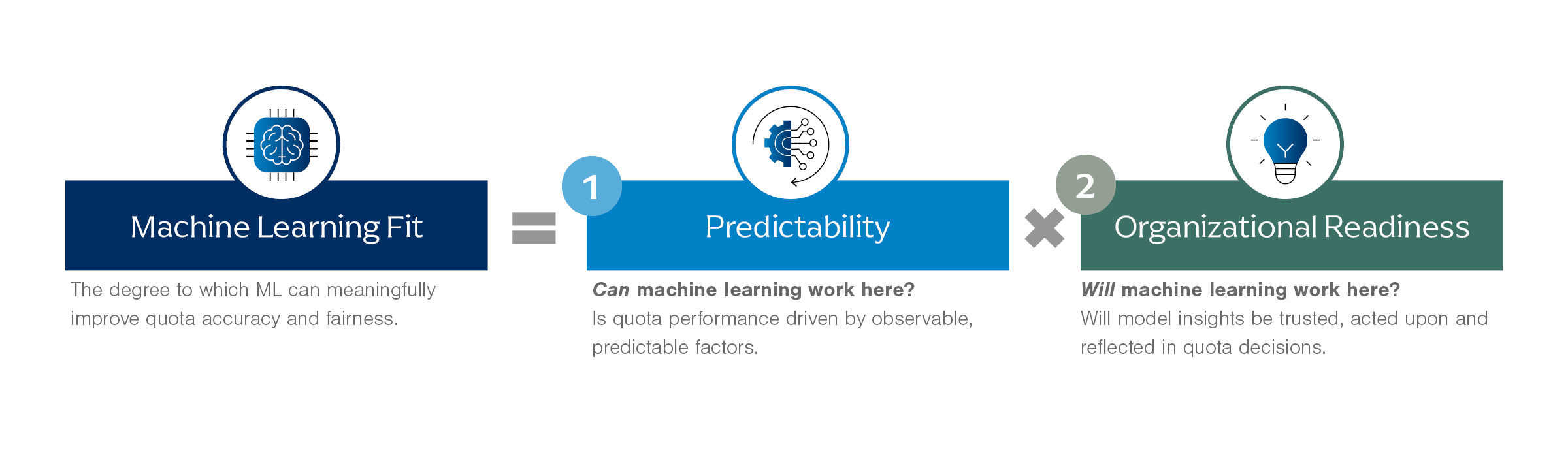
Machine learning makes the biggest difference when outcomes are predictable and when the resulting insights will shape quota decisions. However, not every company is equipped to handle machine learning yet. Two dimensions can tell leaders whether the conditions are right:

First is predictability, which looks at GTM and market stability, buying behavior and revenue dynamics to determine if quota performance variance is driven by observable and predictable factors.

Organizations with low predictability operate in environments where revenue drivers are difficult to forecast. Irregular buying cycles, volatile retention, customized deals, unstable markets and frequent territory changes make it harder for machine learning to accurately identify future opportunity and improve quota-setting decisions. On the opposite end, organizations with high predictability benefit from stable revenue models, repeatable buying patterns, consistent renewal behavior and well-defined territories. Because performance is driven by observable, predictable factors, machine learning can more reliably identify opportunity and support more accurate, equitable quota setting.

The second dimension is organizational readiness, which evaluates data readiness, quota methodology and organizational trust to see if the model’s recommendations will translate into quota-setting decisions and will be reflected in the final quotas.

Organizational readiness extends beyond data quality and governance. In client engagements, one of the most common barriers is not the model itself. Instead, it’s whether leaders and sellers trust the outputs enough to act on them. Companies with low organizational readiness often struggle to turn machine learning insights into action. Fragmented data, heavy reliance on judgment-based decision-making and limited quota differentiation lead to low trust in model outputs, which can prevent even strong analytics from meaningfully influencing quota decisions. Conversely, organizations with high organizational readiness have clean, well-governed data, a willingness to act on model-driven recommendations and a salesforce that views outputs as transparent and credible. In these environments, machine learning insights are more likely to be trusted, adopted and reflected in the final quota-setting process.

Essentially, leaders must not only decide if machine learning can work in their quota setting process, but also if it will work. Predictable opportunity makes machine learning a possibility, but it’s organizational readiness that determines if it’ll drive real quota-setting change.

Choosing the Right Level of ML Involvement

There isn’t a one-size-fits-all approach for applying machine learning, and the right model depends on where an organization lands on the predictability and readiness spectrum:

ML Not Recommended

Best for: Organizations with low organizational readiness, low predictability or both.

Organizations that lack predictable revenue drivers or the readiness to trust and act on model outputs should focus on strengthening those foundational capabilities before introducing machine learning into quota setting.

When outcomes are difficult to forecast, ML models are unlikely to generate reliable recommendations. Likewise, when data quality, governance, leadership alignment or organizational trust are lacking, even accurate model insights are unlikely to influence final quota decisions. In these situations, organizations are better served by improving predictability and readiness before investing in ML-enabled quota setting.

Judgment-led Quota Model

Best for: Organizations with moderate organizational readiness and predictability.

A judgment-led quota model relies primarily on leadership expertise, historical performance and business context to set quotas, with machine learning serving as a secondary input rather than a core decision-making tool. ML-generated opportunity insights may be used to validate assumptions, identify potential blind spots and inform discussions, but final quotas are driven largely by management judgment and established planning processes.

ML-Supported Quota Model

Best for: Organizations that score highly in one dimension and moderately in the other (e.g., high predictability and moderate organizational readiness)

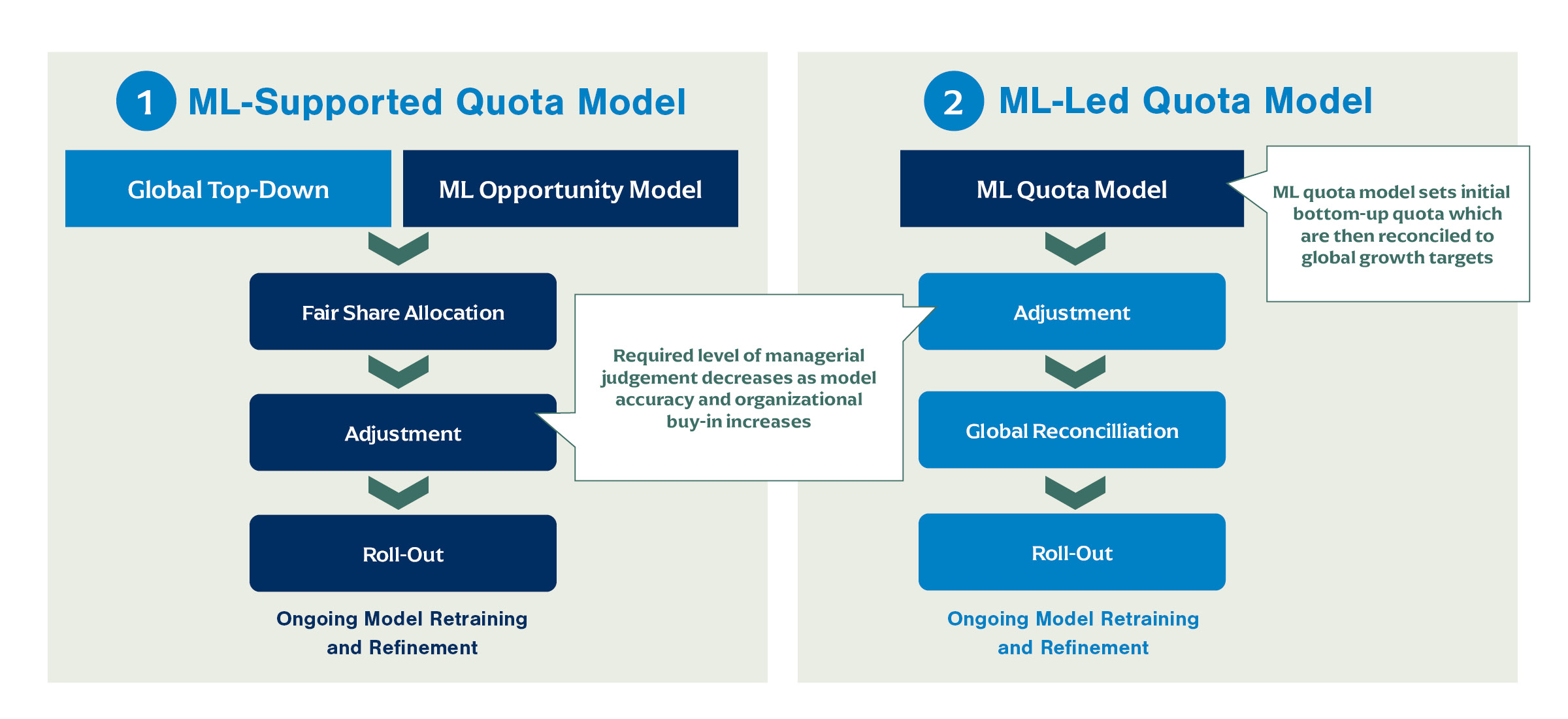
An ML-supported quota model uses machine learning as an input to the quota-setting process rather than the primary decision-maker. The model identifies account, territory and market opportunity to help differentiate quotas, while leadership judgment, business rules and top-down targets remain the foundation of final quota decisions. Although machine learning informs quota decisions, leaders retain primary control over how quotas are set and adjusted.

ML-Led Quota Model

Best for: Organizations that score highly across organizational readiness and predictability

An ML-led quota model uses machine learning to generate the initial quota recommendations based on historical performance, pipeline, account and opportunity data. Leadership then reviews the model outputs, applies governance guardrails and makes targeted adjustments. While leaders are still in the loop, the model serves as the primary driver of quota-setting decisions rather than a supplemental input.

No single model works in every situation, but one rule still holds across all approaches: ML-led quota setting should remain tied to top-down business goals. As model performance improves and trust in the outputs increases, management’s role shifts from setting quotas to validating exceptions, applying governance and ensuring alignment with broader business priorities.

ML-Driven Quota Setting in Practice

After working with Alexander Group, here’s how one organization implemented a data-driven quota-setting approach that supported consistency and fairness in planning.

Challenge: Low attainment required a new approach

Fewer than one-third of sellers were hitting annual quota, more than half sat below 75% attainment and 70% of new hires fell below that same mark. Leadership needed a more consistent, opportunity-based approach to quota setting, free from bias evident in the subjective adjustments.

Solution: A data-driven model recommends, but sales leaders still decide

Alexander Group built an ML-powered opportunity model that combined internal and external data to estimate territory and market potential. Model recommendations were reviewed alongside business rules and leadership judgment, while standardized risk flags helped identify potential issues early.

Impact: Shift from top-down budget math to opportunity-informed targets.

Quotas shifted from primarily top-down allocations to targets informed by territory opportunity, SAM, capacity and growth potential. Sales leaders retained final approval, but had to justify overrides, creating a more consistent and evidence-based quota-setting process.

Three Lessons for Leaders

First, governance and trust matter as much as the model. Machine learning works best when its outputs are explainable, guardrails are in place and leaders are willing to act on those outputs.

Next, predictability and readiness should dictate how far to go. Models that provide quota support fit organizations where readiness or predictability is still maturing. Models that lead quota setting need stable data, consistent go-to-market motions and a real appetite for change.  Organizations that automate before they are ready risk low adoption, poor outcomes and a loss of confidence in the model.

Last, but not least, is that leaders must recognize that quota setting is a multiyear capability. Early cycles focus on insight and calibration while later cycles add automation and scale. Over time, the real work moves upstream, to aligning on assumptions and constraints before quotas are ever set.

Where to Start

Getting started comes down to four steps.

  1. Assess predictability and organizational readiness to decide whether machine learning should inform, support or lead.
  2. Define the quota-setting process, including where machine learning enters, how outputs are governed and how guardrails apply.
  3. Build and validate the model on relevant data so its recommendations stay credible and explainable.
  4. Plan for change management and downstream effects, starting with compensation.

Match the model to the organization’s readiness and the data’s predictability, and machine learning starts building the trust that quota setting depends on.

Replace Quota Guesswork with Data-Backed Evidence

Work with Alexander Group to determine where machine learning can strengthen quota setting and how to begin.

Back to Top