Article
Is Your Pricing Data Ready for AI?
Why Data Quality Matters More in AI-Powered Pricing
In traditional pricing analysis, skilled analysts can work around bad data using intuition. With AI, the model simply reflects the quality of what you feed it.
Common issues we see in pricing data include:
- Inconsistent stock keeping unit (SKU) names, customer IDs or discount fields
- Missing or mismatched transaction details across regions
- No “single source of truth” for price lists, approvals or historical deals
These problems make it harder for AI to draw accurate conclusions, generate clean outputs or identify anomalies.
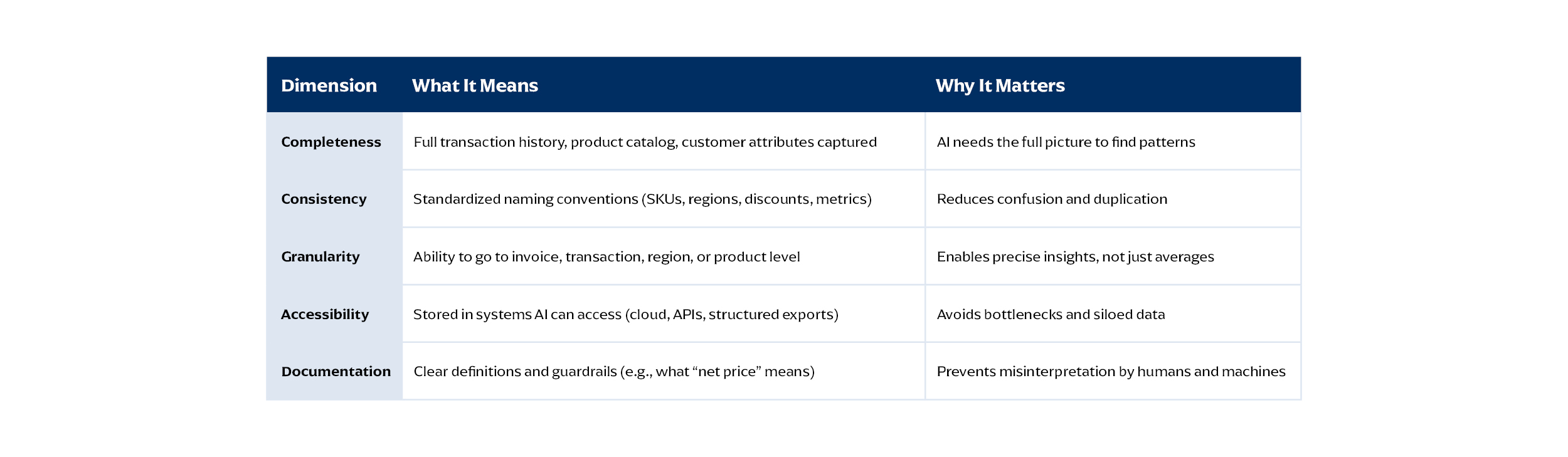
The Five Dimensions of AI-Ready Pricing Data
Think of preparing your data for AI like building a strong foundation for a house. Without it, everything on top becomes unstable.
Common Pitfalls in Pricing Data
Practical Steps to Get AI-Ready
You don’t need to launch a massive master data management (MDM) program on day one. The key is to start small, prove value and build momentum.
Conduct a Data Audit
- Map where pricing-critical data lives today: enterprise resource planning (ERP) software, customer relationship management (CRM) platforms or spreadsheets).
- Identify gaps and overlaps: What do you have, what’s missing and what’s duplicated?
Build a Minimum Viable Database (MVD)
- Instead of waiting for a full-blown MDM project (which can take years), create a lightweight, centralized database focused only on the most critical pricing data.
- Typical starting scope: SKUs, customer segments, transaction history and discounts.
- Benefits:
- Faster to implement (weeks, not years)
- Provides a testbed for AI agents to demonstrate value
- Lower investment risk compared to MDM
Standardize Taxonomies
- Define clear SKU hierarchies, customer tags and discount field logic.
- Even with an MVD, consistency is what allows AI to recognize patterns.
Show Proof of Concept (PoC)
- Run pilots where AI agents use your MVD to automate tasks (e.g., discount analysis, competitive benchmarking).
- Share early wins, like saving hours of manual effort or surfacing insights that were previously hidden.
- This builds credibility and trust across leadership teams.
Build Momentum for Wider Adoption
- Use PoC results to gain sponsorship for larger transformations.
- Momentum matters; small successes create the organizational pull for enterprise-level data governance.
- Over time, you can expand from MVD to full MDM if needed.
Leverage Lightweight Validation Tools
- AI can help flag missing fields, duplicates or anomalies in your MVD.
- Use Python, SQL or even ChatGPT itself for quick data checks.
With this structure, pricing teams don’t need to wait for enterprise IT to deliver a massive master data management (MDM) program. Instead, they can create a minimum viable database (MVM), prove value fast and scale with trust.
The Near-Term Payoff
Even before deploying advanced AI, cleaning and standardizing your data improves:
- Transaction visibility
- Discount policy compliance
- Win-rate analysis
- Dashboards and reporting speed
Beyond AI prep, this will be a direct performance boost to your pricing function.
Start Now, Scale Later
Your data foundation determines how far and how fast you can go with AI. Start by focusing on one domain—discount tracking, transactional data or customer segmentation—and build outward.
When you’re ready to deploy multiple AI agents, this foundation will ensure output consistency, accuracy and trust.
Coming Up Next
Part 5: Beyond Assistants – The Road to Autonomous Pricing
Next, we’ll explore what autonomous pricing might look like in practice, the governance challenges it creates and why human judgment remains central even in an AI-driven world.
Revenue Management Labs partners with Alexander Group to help implement pricing strategies for sustained profitable growth.