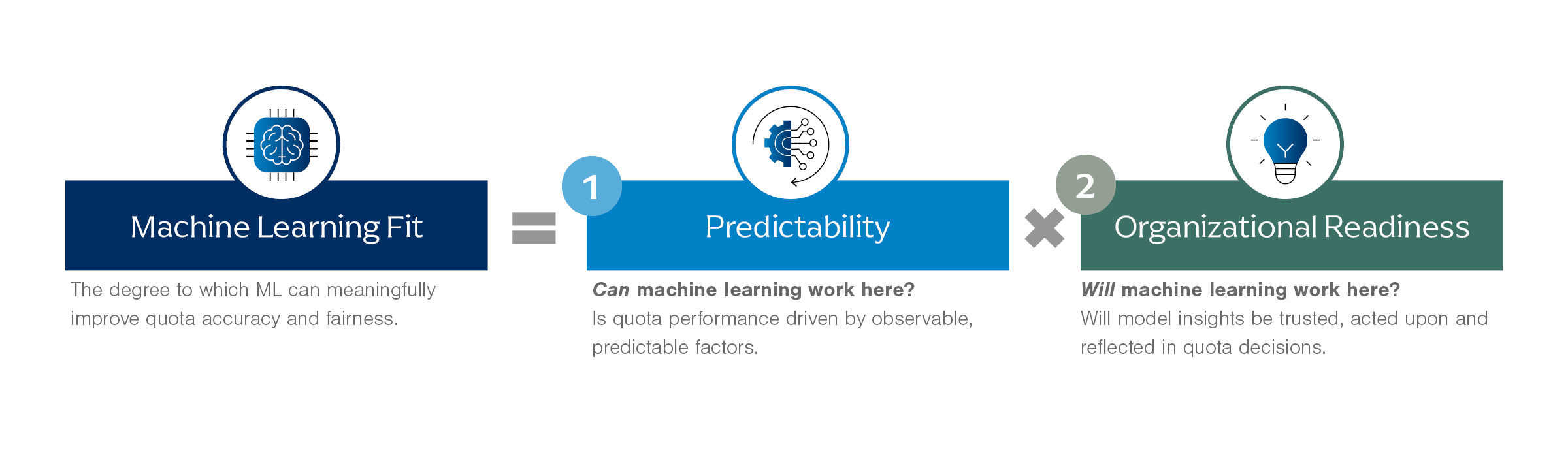
Machine learning makes the biggest difference when outcomes are predictable and when the resulting insights will shape quota decisions. However, not every company is equipped to handle machine learning yet. Two dimensions can tell leaders whether the conditions are right:
First is predictability, which looks at GTM and market stability, buying behavior and revenue dynamics to determine if quota performance variance is driven by observable and predictable factors.
Organizations with low predictability operate in environments where revenue drivers are difficult to forecast. Irregular buying cycles, volatile retention, customized deals, unstable markets and frequent territory changes make it harder for machine learning to accurately identify future opportunity and improve quota-setting decisions. On the opposite end, organizations with high predictability benefit from stable revenue models, repeatable buying patterns, consistent renewal behavior and well-defined territories. Because performance is driven by observable, predictable factors, machine learning can more reliably identify opportunity and support more accurate, equitable quota setting.
The second dimension is organizational readiness, which evaluates data readiness, quota methodology and organizational trust to see if the model’s recommendations will translate into quota-setting decisions and will be reflected in the final quotas.
Organizational readiness extends beyond data quality and governance. In client engagements, one of the most common barriers is not the model itself. Instead, it’s whether leaders and sellers trust the outputs enough to act on them. Companies with low organizational readiness often struggle to turn machine learning insights into action. Fragmented data, heavy reliance on judgment-based decision-making and limited quota differentiation lead to low trust in model outputs, which can prevent even strong analytics from meaningfully influencing quota decisions. Conversely, organizations with high organizational readiness have clean, well-governed data, a willingness to act on model-driven recommendations and a salesforce that views outputs as transparent and credible. In these environments, machine learning insights are more likely to be trusted, adopted and reflected in the final quota-setting process.
Essentially, leaders must not only decide if machine learning can work in their quota setting process, but also if it will work. Predictable opportunity makes machine learning a possibility, but it’s organizational readiness that determines if it’ll drive real quota-setting change.
Choosing the Right Level of ML Involvement
There isn’t a one-size-fits-all approach for applying machine learning, and the right model depends on where an organization lands on the predictability and readiness spectrum:
ML Not Recommended
Best for: Organizations with low organizational readiness, low predictability or both.
Organizations that lack predictable revenue drivers or the readiness to trust and act on model outputs should focus on strengthening those foundational capabilities before introducing machine learning into quota setting.
When outcomes are difficult to forecast, ML models are unlikely to generate reliable recommendations. Likewise, when data quality, governance, leadership alignment or organizational trust are lacking, even accurate model insights are unlikely to influence final quota decisions. In these situations, organizations are better served by improving predictability and readiness before investing in ML-enabled quota setting.
Judgment-led Quota Model
Best for: Organizations with moderate organizational readiness and predictability.
A judgment-led quota model relies primarily on leadership expertise, historical performance and business context to set quotas, with machine learning serving as a secondary input rather than a core decision-making tool. ML-generated opportunity insights may be used to validate assumptions, identify potential blind spots and inform discussions, but final quotas are driven largely by management judgment and established planning processes.
ML-Supported Quota Model
Best for: Organizations that score highly in one dimension and moderately in the other (e.g., high predictability and moderate organizational readiness)
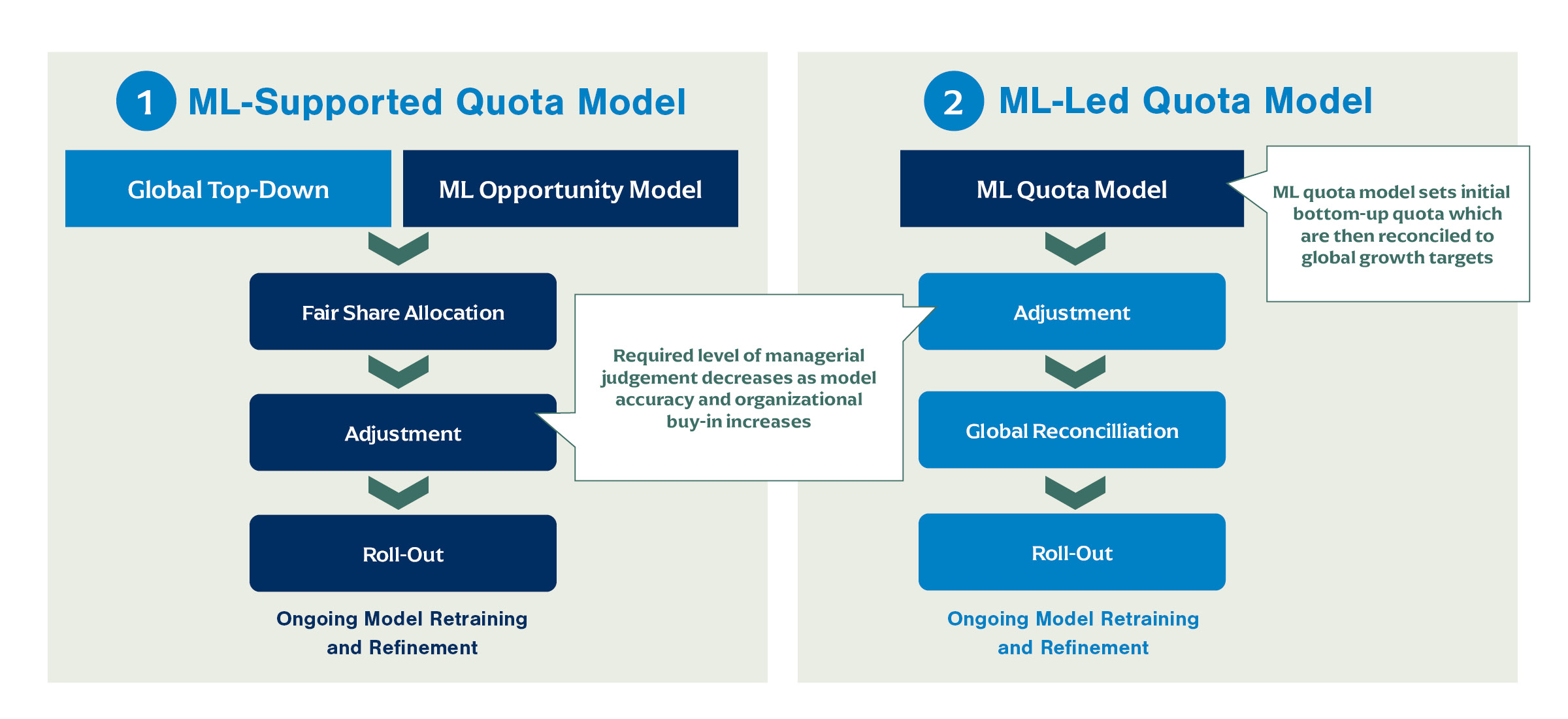
An ML-supported quota model uses machine learning as an input to the quota-setting process rather than the primary decision-maker. The model identifies account, territory and market opportunity to help differentiate quotas, while leadership judgment, business rules and top-down targets remain the foundation of final quota decisions. Although machine learning informs quota decisions, leaders retain primary control over how quotas are set and adjusted.
ML-Led Quota Model
Best for: Organizations that score highly across organizational readiness and predictability
An ML-led quota model uses machine learning to generate the initial quota recommendations based on historical performance, pipeline, account and opportunity data. Leadership then reviews the model outputs, applies governance guardrails and makes targeted adjustments. While leaders are still in the loop, the model serves as the primary driver of quota-setting decisions rather than a supplemental input.