In today’s customer-centric landscape, many technology companies have adopted consumption-based pricing models. According to Alexander Group data, approximately 40% of technology companies are currently utilizing this model, and the number continues to increase. Consumption pricing models have a major impact on many go-to-market (GTM) practices. Not only do companies need to revisit their business metrics, customer billing practices and systems/tools, they must also re-evaluate their coverage model, seller behavior and the sales compensation plan. Because the structure of sales compensation is directly influenced by both the contract type and the coverage model, selecting the right sales compensation measures requires a clear understanding of these foundational models.
Contract Models and Their Impacts on Sales Compensation
There are three main types of consumption-based contract models: committed spend, uncommitted spend and pay-as-you-go. Each type requires unique sales approaches and comes with its own set of factors to consider when determining core sales compensation measures.
- Committed Spend: Customers agree in advance to spend a set amount of money. While this upfront commitment is similar to traditional subscription models, it differs because sellers must actively track and encourage usage—ensuring customers meet their committed spending level. With this model, vendors have visibility into their future revenue and customer discounts for pre-committing to a spend amount.
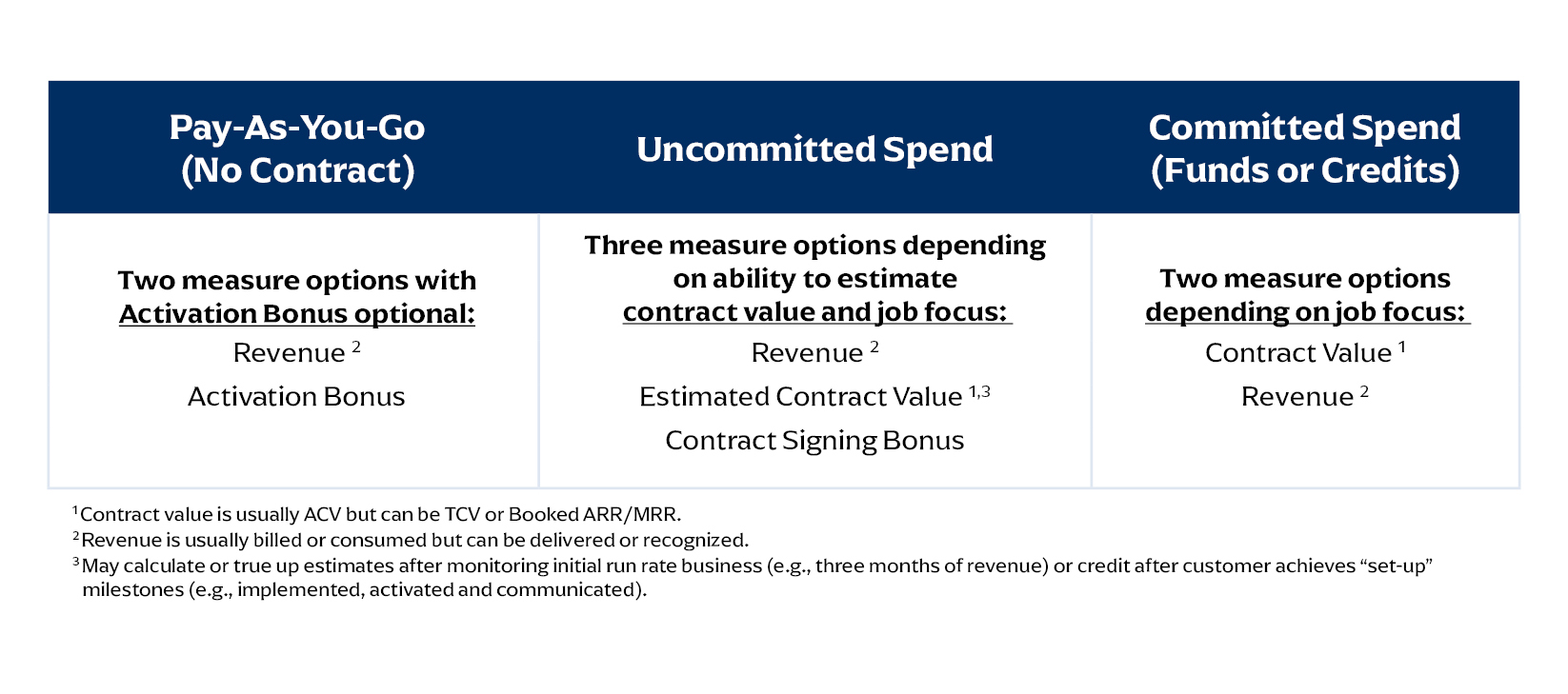
- Sales Compensation Implications: Like standard SaaS approaches, the measures in this model include bookings (such as ACV). It also includes consumed revenue metrics to encourage sellers to drive usage across current and new use cases.
- Uncommitted: This contract type does not specify a set dollar amount from the customer. Instead, it outlines terms like pricing and duration. That way, the customer only pays for what they actually use. These contracts are common in industries like fintech, e-commerce and digital media/ad-tech, where vendors receive a fee for transactions going through their platform or a percent share of the customer’s revenue. This model provides flexibility for customers, allowing them to pay only for what they use without being locked into a minimum spend.
- Sales Compensation Implications: The primary measure in this model is consumed revenue to focus on actual revenue. To drive contract signings, some companies may include a lower weight measure or an add-on measure focused on estimated contract value, particularly if they have a valid method to predict the value. Other companies may use a complex measurement solution that provides partial credit/payment at the time of contract signing and then the remaining payment at the time of consumed revenue.
- Pay-As-You-Go: Customers pay based on actual usage without any upfront commitment or contract. This model demands continuous persuasion from sellers since customers can cancel anytime. Of the three contract models discussed, this is the most flexible one. This model is typically used in the SMB space, for trials and for add-on modules.
- Sales Compensation Implications: The main measure in this model is consumed revenue. Occasionally, a small upfront payment or sign-up bonus is provided for contract closure. Some companies define a “new user” only when their spending reaches a set threshold, ensuring user commitment beyond trial participation.