

Hunter vs. Farmer vs. Generalists Sales Models
Revenue and Sales department leaders build sales forces with team members who fulfill specific purposes. Some sales team members focus on growth, while others nurture the existing customer base. In some instances, members of a Revenue and Sales department may fulfill both roles.
Success within these growth-, nurturing- and dual-focused sales roles requires certain personality traits. By identifying the optimal personality traits for sales roles, leadership teams can hire the right talent and reward the characteristics that drive revenue. This article will describe three essential sales models—the Hunter, Farmer and Generalist—and explain how a leadership team can choose the right model for their personnel.
Hunter Sales Model
Most Revenue and Sales department leaders aim to hire a sales staff of Hunters to acquire new accounts and/or get more business from existing accounts. Hunters aggressively seek opportunities to increase revenue. Their eagerness and confidence allow them to drive sales even when pursuing the most challenging game. Any Hunter must practice persistence and persuasiveness. Rewarding Hunters with commission brings out the tenacity the leadership team desires.
If the sales job is a pure Hunter, a clean handoff to a capable customer support team, renewals team or “Farmer” sales role is required to handle the ongoing account needs (assuming there are ongoing account needs).
Farmer Sales Model
Sustained success requires a commitment to a business’s existing customer base. After all, there is plenty to harvest at home while the Hunters pursue new opportunities. The Farmer cultivates growth by tending to existing customers.
Farmers are account holders that fill customer-nurturing roles to ensure the customer’s continued satisfaction. As the traditional farmer replants seeds from each year’s harvest, the sales Farmer cultivates revenue opportunities by pushing renewals, upgrades and add-ons.
The Farmer must make customers feel welcomed and appreciated, requiring a warmer approach than that of the Hunter. Sales Farmers should display a friendly demeanor and embrace opportunities to strengthen their relationships with customers.
Generalist Sales Model
Many organizations blend the Hunter and Farmer into one role, sometimes referred to as a Generalist or an Account Manager. A Generalist must display dexterity and versatility. Sellers in Generalist roles will interface with new leads and existing customers alike. The ability to switch between a fervent or nurturing demeanor depending on the client is critical.
The Generalist approach gives the sales leader the flexibility to deploy this role across a wide range of geographies and account portfolios with different mixes of business.
The downside of the Generalist approach is a lack of focus. The Generalist might become a “jack-of-all-trades, master of none,” as the saying goes. Or worse, the Generalist can get caught up in post-sales activities such as contracting, billing, shipping, customer support, customer service, and the like, resulting in little to no time for hunting.
And so the sales leader is faced with a choice to either:
- Deploy the more flexible but potentially less growth-oriented Generalist and drive hunting focus through management and compensation.
- Create a pure hunting role to focus on new business.
- Do both.
How Should Sales Leaders Determine the Right Model for Their Sales Force?
How should sales leaders determine the right model for their sales force? Should the decision be based on company size and maturity, or the type of product or service, or the nature of the selling process, or the type of customer, or the complexity of the sale, or the personality types of their sales reps or other factors?
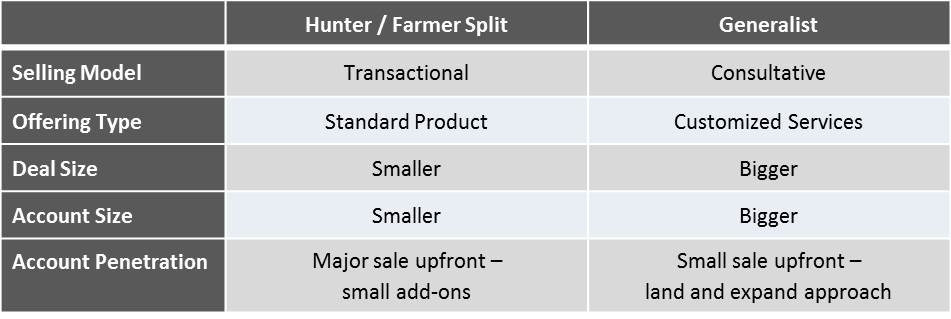
Alexander Group encounters these questions while working with clients across multiple industries, and while a complete answer is beyond the scope of this article (as it can and often is influenced by ALL of the above factors), there are some practical guidelines to consider when deciding between a Generalist versus a Hunter/Farmer model, as follows:
Hunter-Farmer Split Model
The split model achieves the desired focus on hunting. It is best suited for offerings that are already or more easily understood by the marketplace, have a more quantifiable value to the customer, and thus are more of a “known quantity.” These offerings therefore, generally require less of a consultative sales effort. They may represent big offerings sold to big accounts but are usually smaller in deal size.
The split model’s sales effort is highly “front-loaded,” meaning once the first sale is made, there is less ongoing selling to be done. The type of separate Farmer role needed will depend on these same factors—the more these factors are true (transactional, standard, smaller, up-front) frankly the less a Farmer job is even needed and a simple customer services or support organization will suffice.
Generalist Model
Newer offerings that require more missionary or visionary selling and thus a higher degree of trust in the value or impact of the offering are often better served by the Generalist. In these instances, the customer expects the salesperson to stay more involved past the initial sale to address lingering doubts or ambiguity and to ensure ultimate success. In many cases, the customer forms a bond with the salesperson based on trust.
The offerings that a Generalist endeavors to move are typically more complex, involving more ongoing services. Quite often, the first sale is just a starting point for the relationship. The Generalist aims to establish a “beachhead” in the account from which to expand into other parts of the customer’s organization, maintaining and growing relationships and the business over time.
What About Both?
Some sales leaders will deploy both models against the same customer segment, typically with pure Hunters assigned to green territories and Generalists covering established territories. In most cases of this nature, the successful Hunter transitions over time into a Generalist.
Learn New Ways to Shape Your Sales Force With Alexander Group
Alexander Group will leverage decades of experience to drive your revenue organization to actualize its growth potential. Contact Alexander Group online to discuss how your Revenue and Sales department can transform its coverage model.


Contact Us
Learn more about designing the best sales coverage model for your sales force.

