Skip to Main Content
Business Services

Sustain Growth Momentum into Q2

Q1 brings a burst of energy for many organizations. Sales kickoff commitments are fresh, new priorities are clear and pipelines often show early promise. Yet by mid-Q2, that momentum frequently stalls. Activity rises, but results flatten. Leaders ask the same question every year: Why does early momentum fail to translate into sustained growth?

The challenge is not strategy. Most organizations enter the year with well-defined go-to-market plans. The real constraint is execution. After several client engagements and projects, our team has noticed that change has become continuous. Demand models evolve, sellers face more noise and managers are stretched across coaching, forecasting and change leadership. Without intentional reinforcement, even strong Q1 starts eroding quickly.

Maintaining momentum into Q2 requires focus on three levers that consistently separate growth leaders from laggards: modern demand generation, targeted short-term incentives and empowered first-line sales managers. When these elements are aligned and operationalized, organizations move from early acceleration to sustained performance.

Close

Demand Generation Has Shifted from Volume to Precision

Demand generation in business services has fundamentally changed. Instead of just focusing on creating more leads, success is dependent on creating the right leads and moving them faster through the funnel.

From the Alexander Group’s point of view, high-growth organizations are far more likely to unify marketing, sales and service around shared data and prioritization models. Leaders carefully define ideal customer profiles and invest in lead scoring models that focus seller time on accounts with the strongest right to win.

The impact is material. Leaders deploy AI-enabled inbound and outbound lead management at higher rates than lower-performing peers, particularly in pre-sales activities. In one research example, AI-powered inbound lead management reduced the average time to quote from days to hours. This reduction improved both pipeline velocity and customer satisfaction.

The lesson for executives is clear. Momentum slows when sellers chase low-quality opportunities. It accelerates when demand generation becomes a precision engine that feeds sales teams prioritized, conversion-ready opportunities.

Short-Term Incentives Work When Used with Discipline
Special performance incentive funds, or SPIFs, are often misunderstood. When misused, they create noise or undermine core compensation plans. Yet well-designed SPIFs are among the most effective mid-year levers for driving targeted behavior change.

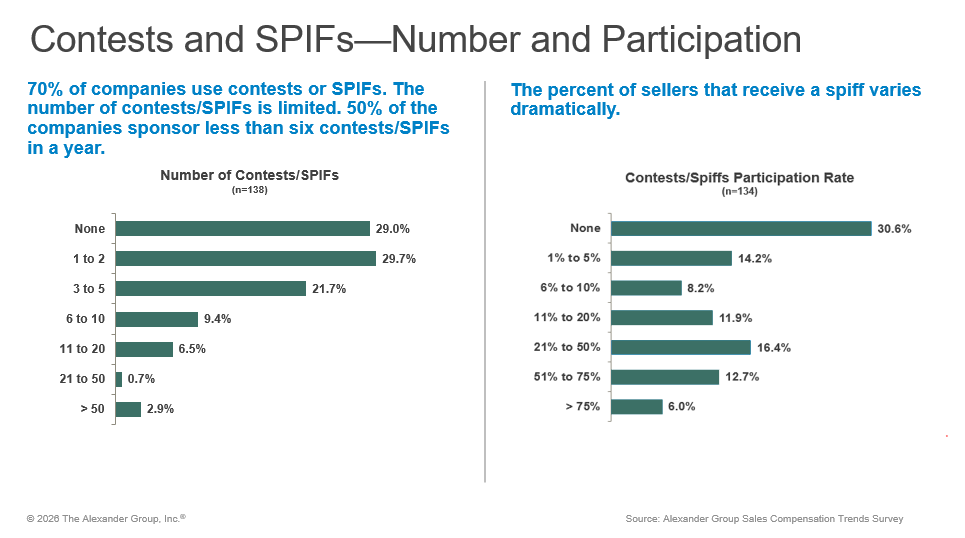
Drawing from Alexander Group data, roughly 70 percent of companies use contests or SPIFs, but most limit them to a small number per year to avoid fatigue. The most successful programs share four common traits: clear objectives, finite timeframes, attainable goals and payouts meaningful enough to motivate effort.

Effective SPIFs do not reward what is already paid through the core compensation plan. Instead, they focus on specific priorities such as smoothing revenue seasonality, accelerating the traction of a strategic offering or driving critical sales milestones in the middle of the year.

For leaders who don’t want to lose ground in Q2, SPIFs provide a way to re-focus the field without redesigning compensation. Right when attention starts to drift, the right SPIFs will act as a targeted nudge that reinforces strategy.

First-Line Sales Managers Are the True Momentum Multipliers

No role has more influence on sustained execution than the first-line sales manager. However, Alexander Group research consistently shows a gap between their perceived importance and how they are formally enabled.

Managers are widely viewed as critical to driving change, and yet leading change and driving adoption rarely appear as a primary responsibility. Instead, managers are measured first on quota attainment, with coaching and change leadership treated as secondary activities.

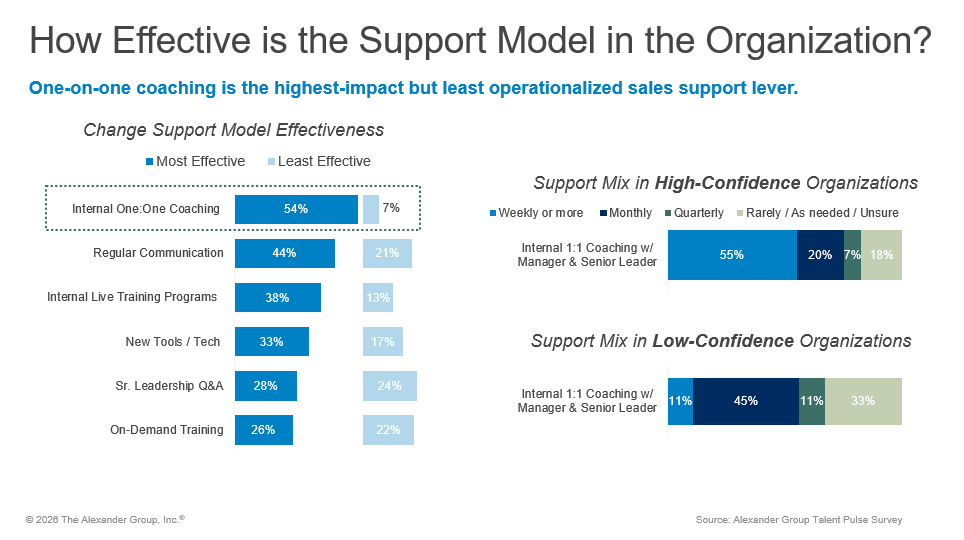
This misalignment matters. Research shows that one-on-one coaching is the most effective support mechanism for driving change, but it is often the least operationalized. High-confidence organizations are far more likely to conduct frequent coaching sessions focused not just on deals, but on skill development and behavior change.

Progress stalls when managers are overloaded and under-supported. It accelerates when they are equipped with clear playbooks, realistic spans of control and the expectation to act as performance multipliers across their teams.

Adoption, Not Design, Determines Impact

Across demand generation, incentives and talent, a common theme emerges. Instead of design driving results, it’s actually adoption that’s the deciding success factor.

Organizations today are navigating simultaneous changes, including new offerings, evolving coverage models, AI investments and shifting customer preferences. In this environment, execution becomes the limiting factor.  However, we believe that adoption, reinforced through operating rhythms and frontline leadership, is now the primary determinant of go-to-market impact.

To keep pushing ahead into Q2, leaders need to move beyond launching initiatives and focus on hardwiring them into day-to-day execution.

Executive Recommendations: How to Maintain Momentum into Q2

Commercial leaders should focus on four practical actions:

  1. Re-prioritize demand generation around conversion instead of activity. Audit where sellers are spending time today. Tighten ICP definitions, refresh lead scoring and ensure marketing and sales are aligned on what constitutes a priority opportunity.
  2. Deploy SPIFs with surgical precision. Limit programs to one or two clearly defined objectives tied to mid-year priorities. Keep durations short, measures simple and payouts meaningful enough to drive participation.
  3. Elevate first-line sales managers as owners of execution. Clarify expectations for coaching and change leadership. Provide managers with playbooks, tools and dedicated time to coach their teams consistently.
  4. Reinforce through operating rhythm. Hardwire reinforcement into weekly and monthly cadences. Review progress, share wins and course-correct quickly. Progress is sustained through repetition and visibility.

Turning Early Energy into Enduring Performance

The path to sustained growth is not about working harder in Q2. It’s about working differently. Organizations that maintain momentum treat demand generation as a precision engine, use incentives to refocus effort and empower managers to lead change at the front line.

In a world where change is continuous, execution discipline becomes a competitive advantage. The organizations that win are those that convert early energy into durable performance by reinforcing the fundamentals that matter most.

Don’t let Q1 progress stall

For executives looking to translate Q1 momentum into full-year results, now is the moment to act. Schedule a briefing with Alexander Group to explore how leading business services organizations are sustaining growth through smarter demand generation, targeted incentives and frontline leadership excellence.

Back to Top