Sales Compensation Harmonization to Unlock Integration Growth

Private equity firms often use mergers and acquisitions (M&A) as a key value creation strategy. Investors start with a core business or platform, then enhance it by adding new capabilities and expanding into new regions. When a company integrates newly acquired businesses, management must work diligently to smoothly bring all functions—including sales—together. One important aspect they must align is the sales compensation program.
The sales compensation program is a critical lever to drive strategic goals and growth expectations. Not only is it a major proportion of any company’s sales and marketing budget, but it’s also an emotional program as it affects people’s livelihoods. A poorly designed program brings with it significant negative consequences, including missed growth goals, seller turnover and budget overages. In an M&A environment, the right program balances the need to realize integration synergies with retaining top talent and minimizing customer disruption.
Alexander Group recently partnered with a life safety business owned by a private equity firm. This company had experienced rapid inorganic growth after acquiring over 100 businesses in just six years. However, the organization never integrated its sales teams—leading to myriad disconnected sales compensation plans. Leadership was unable to determine if the sales compensation plan was paying sellers appropriately, driving the right behaviors and aligning pay to the company’s strategic growth objectives.
To address these issues, the company sought Alexander Group’s help in standardizing its sales compensation program. For this engagement, our team utilized three guiding principles:
- Drive Company Strategy
- Attract and Retain Top Talent While Minimizing Customer Disruption
- Establish a Centralized Plan Governance Model
Drive Company Strategy
As previously stated, the sales compensation program is a vital lever for driving strategic goals. Behind this drive is a key sales compensation element: the selection of the plan measures and their mechanic. It’s usually important to drive cross-selling after an integration to maximize growth synergies. There are multiple ways to drive cross-sell, from small plan elements like a referral bonus to a major plan element like a cross-sell product measure.
The right solution will depend on many factors like how the sales teams were integrated, rules of engagement, strategic importance and ability to set quotas. It was strategically important for our life safety client to drive cross-selling for their integrated sales team, so they decided to incorporate a cross-sell product measure in the plan.
Attract and Retain Top Talent While Minimizing Customer Disruption
Many businesses need to attract and retain top talent to maximize their value creation. They may also strive to minimize customer disruptions when setting up new sales territories. Thus, some companies will develop the optimal future go-to-market model, but move some sellers to the new roles, territories and sales compensation plans over time. This approach balances immediate priorities with long-term goals. For our life safety client, we prioritized minimizing customer disruption during integration, even if it required temporarily overpaying some sellers.
Establish a Centralized Plan Governance Model
Creating the integrated sales compensation plans is only the first step. To successfully administrate and manage the program on an ongoing basis, companies also need strong governance and change management. Key program management phases include plan, assess, design, implement, administer and manage.
Decentralized administration and governance can lead to inconsistent practices, separate reporting and higher program management costs. With this client in particular, it resulted in fragmented plans, weak collaboration and too many people managing the program. Alexander Group recommended that the organization create a centralized sales compensation operations team to improve reporting, insights, efficiency and scalability.
Conclusion
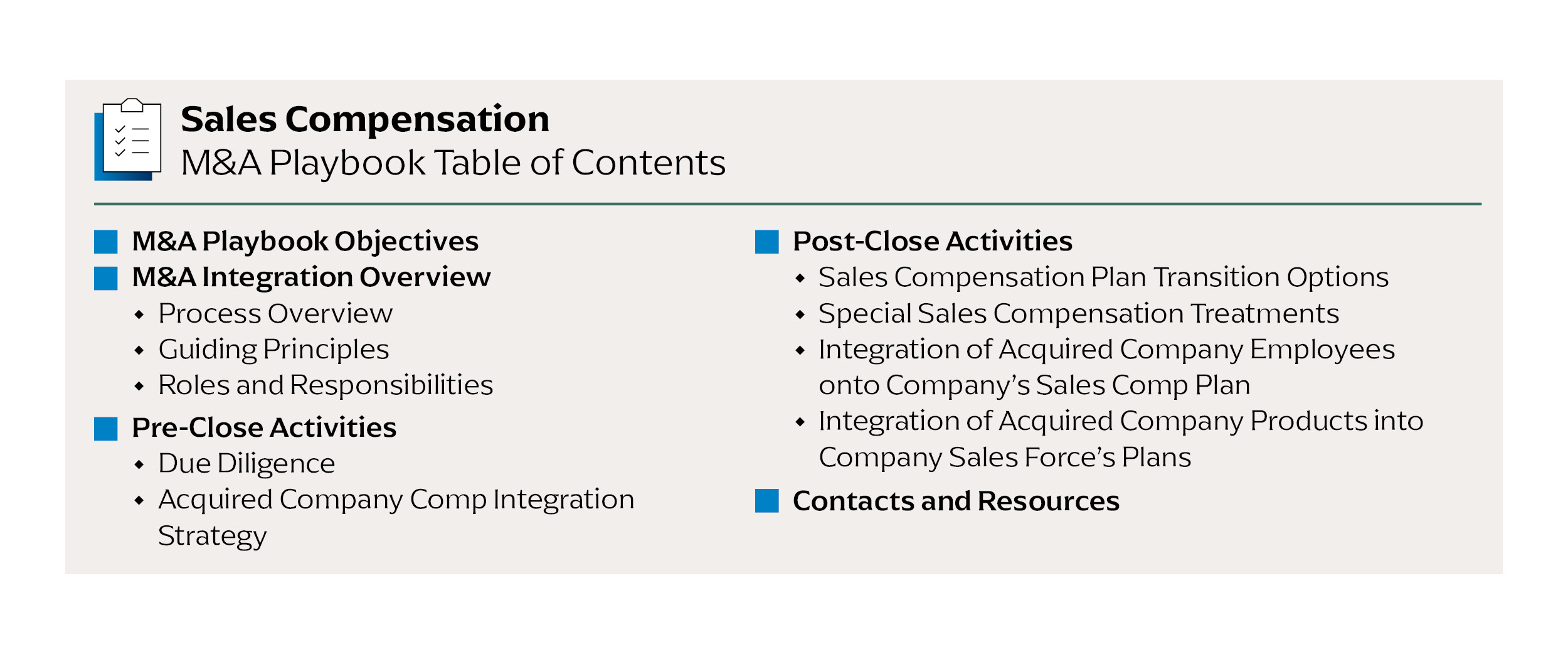
Sales compensation harmonization is crucial for private equity firms pursuing platform expansion investments. Unfortunately, most companies do not have a formal approach on how to integrate their sales compensation program. Alexander Group research reveals that just 36% of businesses have a written framework for integrating sales compensation during their M&A. A well-structured M&A playbook defines clear principles, outlines activities/owners and provides a set of standard sales compensation options to select from.


Ready to improve your sales compensation integration?
For more information on how to integrate sales organizations, merge sales compensation programs and/or build a M&A sales compensation playbook, reach out to one of our PE practice leaders.