

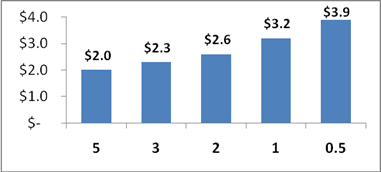
SE to Sales Rep Ratio
Companies often deploy Sales Engineers (SEs) to help demo and customize technical solutions. SEs are considered overlay as they typically are tied to one or more rep quotas. Deploying SEs is, therefore, an added cost to the sales force. Calculated deployment using Sales Engineer best practices promotes cost efficiency in the pursuit of revenue growth. (see chart below).
SE to Sales Rep Ratio
In technological and scientific industries, products and solutions are often complex. Communicating their value requires acute product knowledge in addition to sales acumen. Sales organizations in these industries deploy Sales Engineers to increase sales and optimize sales processes. A Sales Engineer is a multifaceted seller for organizations that provide technological or scientific products.
Sales Engineers make the sales process more consultative and collaborative. They foster close relationships with clients to deepen the organization’s understanding of its customers’ needs. Additionally, they collaborate with the Sales department to align the go-to-customer strategy with customer demand.
Interactions with both ends of the transaction help companies improve solutions and refine sales strategies. In this way, SEs function as revenue engineers. The SE identifies and addresses opportunities to elevate sales efficiency in scientific and technological industries.
Sales Engineers provide value to the sales organization and the customer.
For the sales organization, the SE can elevate sales per representative. The SE comes to understand the customer’s needs and relays that information to the Sales department. These findings influence everything from solutions customization to sales strategies. The SE’s guidance helps sellers address specific customer needs, promoting higher revenue contribution from each team member.
SEs help the customer by improving the solutions and their understanding of those solutions. As a product expert and sales professional, the SE can convey the solution’s value effectively. SEs often conduct demos that exemplify the impact a technological or scientific solution can make. These interactions also serve to manage customer expectations. The result is a strong, transparent relationship between the seller and buyer. The customer-side advantages boost satisfaction, contributing to retention and future sales.
Are Sales Engineers worth the investment? To find out, Alexander Group evaluated the sales rep productivity of 100 sales forces in our benchmark database. As expected, companies with higher SE-to-rep ratios have higher revenue per rep. On average, sales forces with a 1:5 ratio—1 SE for 5 reps—have revenue per rep of $2 million, while sales forces with a 1:1 ratio average $3.2 million per rep. (see chart below).
Insert chart: https://prnt.sc/gdM6drcTURT2
A correlation exists between the SE-to-rep ratio and revenue. Maintaining an even balance may deliver increased revenue-per-rep. Does this mean you should hire more SEs? The answer depends on a variety of factors. To determine the optimal ratio of SEs to reps the following factors should be evaluated:
For complex solutions sold to top Enterprise customers, sales reps are typically paired 1 to 1. Large global account reps may even have multiple SEs supporting them. However mid-market reps are typically paired 1:2 or 1:3, and certain solutions may only call for one SE for every five or six reps. Best practice companies evaluate their SE roles, headcount, and deployment ratios on a regular basis, making sure that the investment in these highly skilled resources is realizing the desired return.
In the sales process, different types of Sales Engineers play crucial roles in ensuring success.
Sales Engineers typically specialize in either pre- or post-sales duties, but some perform both roles depending on the organization’s needs.
Sales Engineers provide several benefits that can significantly enhance a sales team’s performance:
Sales Engineers offer immediate access to in-depth product knowledge, a crucial asset for sales reps. Even though sales teams undergo training, they often face complex, technical questions from prospects. Having a Sales Engineer on hand allows these questions to be answered swiftly and accurately without involving the engineering team. Doing so ensures that prospects receive detailed explanations tailored to their specific needs.
When a Sales Engineer conducts product training, it becomes significantly more effective. Their deep understanding of both the product and the sales process allows them to train sales reps in a way that connects product features to client needs. This approach improves the reps’ ability to demo the product, showcase how it can benefit potential clients and address pain points.
Setting and managing client expectations is crucial. Sales Engineers can clarify what clients should expect from the product or service. Identifying and addressing the client’s needs early helps prevent misunderstandings and misalignment. This clear communication enhances client satisfaction, as they are more likely to be pleased with a product that performs as expected.
Sales Engineers are key in developing an initial success plan for new clients. They use their understanding of the prospect’s needs to outline the best approach for implementing the product. Whether dealing with straightforward data integration or more complex setups, they provide a clear plan before a client signs the contract. This transparency helps close deals by ensuring clients understand their future experience and what to expect.
The handoff from sales to customer success is more efficient with a Sales Engineer involved. Their customer success experience enables them to effectively bridge the gap between sales and implementation teams. By understanding both the clients’ needs and the consultants’ requirements, Sales Engineers facilitate a smoother transition and kick-start the implementation process. This seamless handoff leads to a better client experience and quicker setup times.
To effectively measure the performance of Sales Engineers, consider these KPIs:
By nature, the SE role strives to communicate precise benefits unique to the buyer’s solution. This reality makes solution selling an effective way to drive revenue using SE deployment. SEs use a consultative approach to understand the buyer’s needs and tailor solutions accordingly. Sales Engineers can maximize their impact by adopting the following best practices:
Sales organizations deploying SEs can implement various practices and policies that maximize each SE’s value. As you design an SE strategy, compensation plans, SE training and revenue tools become integral considerations.
The organization’s SE compensation plan should align with the value an effective SE can provide. A Sales Engineer serves numerous roles and completes various tasks—each warranting consideration within the compensation plan.
While the SE role is complex, compensation plan simplicity can go a long way. Offer a straightforward compensation plan with a clear balance between base salary and commission. The typical SE compensation plan establishes a base salary that provides 60%-75% of the seller’s pay. The remaining 25%-40% comes from commission. Finding the right balance is a critical part of maintaining profitability and retaining top SEs.
Robust training and development programs streamline SE success. With sufficient training, new SEs can begin generating value for the organization sooner. Meanwhile, development programs help to convert existing sales associates into expert Sales Engineers. Training and development strengthen the seller’s understanding of the products they sell. They gain technical expertise while learning to convey unique selling points to the buyer. Training and development are most effective as ongoing strategies. While SEs will undergo initial training, continued learning helps them stay sharp and agile.
SEs, like any seller, benefit from implementing revenue tools.
The SE’s multifaceted role necessitates customer relationship management (CRM) software with collaborative functionality. A CRM allows SEs to compile and analyze customer data, driving sales and facilitating process optimization. Ensuring visibility throughout the Sales department helps the SE share findings with more sellers.
Product demo tools are also powerful revenue enablers for SEs. Providing a demo platform allows SEs to display the value of a product consistently and efficiently.

Whether you're selling to top enterprise customers, managing mid-market reps or dealing with global accounts, Alexander Group provides tailored solutions. Our sales engineering revenue solutions streamline SE implementation in complex industries. Contact us online to get started today.


