


The Five Foundational Tenets for Managing the Sales Compensation Program
Alexander Group’s recent sales compensation research shows that only about one in five companies rate their sales compensation plan as “very effective,” and those high performers consistently outperform peers in quota attainment, seller retention and disciplined investment.
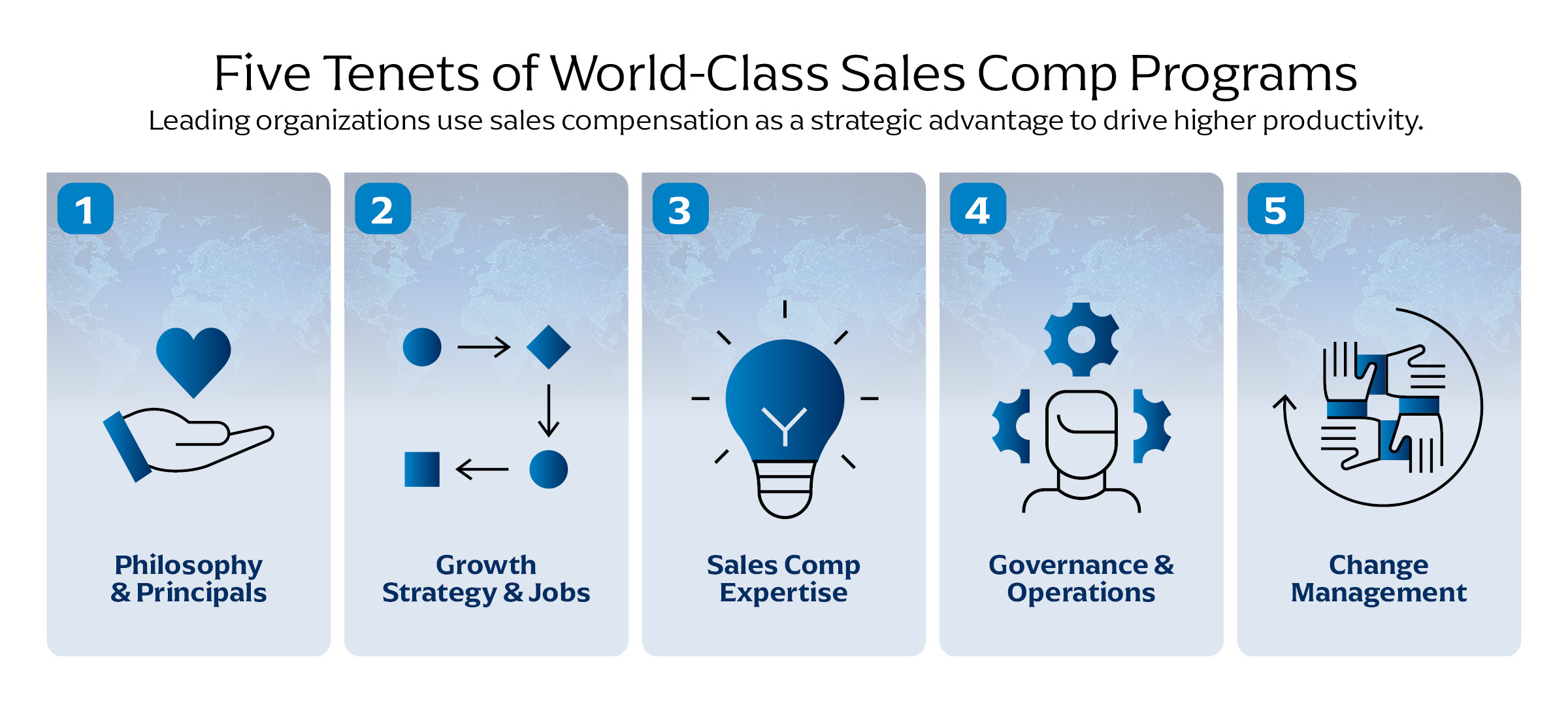
The plan design itself is not what enables these organizations to stand out. Rather, best-in-class companies put the right foundation in place to manage the full end-to-end sales compensation process. Alexander Group’s five tenets—Philosophy and Principles, Growth Strategy and Job Clarity, Sales Compensation Expertise, Governance and Operations and Change Management—define the elements companies need to manage the program effectively.
1. Philosophy and Principles
Every effective sales compensation program starts with clearly articulated philosophies, or a stable set of beliefs about why the company pays sellers the way it does. A strong philosophy answers foundational questions.
- What is the role of sales compensation within the company’s broader talent strategy?
- At what market pay percentile does the company want to position pay levels to attract and retain talent?
- What is the organization’s pay-for-performance philosophy to differentiate top and bottom performers?
- How well does the firm want to align pay to individual, team or group results?
- What outcomes should incentives drive, and what should be managed through other leadership tools?
Having clear and consistent answers to these questions gives leaders a common lens for assessing current plan structures, evaluating design changes, resolving trade-offs, managing exceptions and making mid-year change decisions.
Companies should also build a set of guiding principles across each plan design component: eligibility, pay levels, pay mix, measures, mechanics, pay curves, performance period and payout frequency. This will ensure alignment across jobs, regions and/or business units. Documenting and socializing company philosophies and guiding principles creates a practical litmus test for future decisions and helps ensure the program remains aligned as the business evolves.
2. Growth Strategy and Job Clarity
Sales compensation is one of the most powerful tools leaders have to drive strategic goals and desired behaviors. To use it effectively, leadership must first align on the company’s revenue growth strategy.
- Where will growth come from: new, cross-sell, upsell?
- How do we maintain gross revenue retention (GRR) and net revenue retention (NRR)?
- Does the company want to prioritize single-year or multi-year deals?
- Should the plan create emphasis or parity across different products and pricing models?
Coverage models are becoming increasingly complex. More companies are moving from land and expand sellers to lifecycle sellers (ranchers) or bifurcated hunter and farmer models. Most sellers leverage solution engineers and product specialist roles to sell their highly technical solutions portfolio, while customer success and renewal roles are used to offload adoption and renewal activities to lower cost resources. Many companies leverage channel and alliance roles to drive resell, sourced and influenced business.
If the sales compensation plan doesn’t align with strategic goals, sellers will naturally gravitate toward what the plan rewards, even if that behavior conflicts with leadership priorities. When job accountabilities are unclear, plans often become overloaded with weighted measures, add-on bonuses, credit uplifts and downlifts, hurdles and gates. The result is seller frustration, confusion and weaker line of sight.
Growth strategy drives job role clarity, which drives plan design clarity. Therefore, the annual sales compensation process should test whether each plan reinforces the specific outcomes each job is expected to deliver.
3. Sales Compensation Expertise
The third tenet is the company’s level of internal expertise to manage the program. Sales compensation within the technology industry is uniquely complex. Stakeholders are wrestling with how to create a simple plan that accommodates multiple strategic goals within a cost envelope. They must understand all the different plan design options (measures, mechanics, crediting rules and policies), their application and pros/cons. Additionally, they must be able to predict unintended consequences such as windfalls, gaming, demotivation and/or cost misalignment.
Sales compensation leaders also need strong process management and stakeholder influence skills. Because sales compensation decisions are highly visible and often debated, sales compensation leaders must align sales leadership, revenue operations, finance, human resources and executive leadership on both what to do and what not to do. Without a disciplined process, competing perspectives can lead to weak alignment, delayed decisions and limited buy-in.
World-class programs draw on a combination of internal business knowledge and external market perspective. Leaders should know how their plan’s pay mix, leverage, upside opportunity, measures, mechanics and quota practices compare to companies of similar scale, growth profile and go-to-market complexity. This market data should not dictate design decisions, but it should inform them.
4. Governance and Operations
Sales compensation organizations need the right people, process and tools to effectively manage their program at the right costs. A clear governance charter should define ownership across the key stakeholders in the process, including sales leadership, revenue operations, finance and human resources. This includes determining who sanctions the guiding principles, who facilitates the design process, who models costs, who approves the program, who communicates the plans and who administers payouts. Alexander Group’s research finds that high-performing organizations are 12 points more likely to hold standing leadership meetings to review sales compensation metrics.
Operational discipline matters just as much. Crediting rules have to apply consistently across every transaction, and payouts have to be accurate, timely and transparent. Exception management holds up only when it follows a documented process applied the same way every time, while metrics and dashboards earn their place only when they stay current and reach leadership on a regular cadence. Incentive compensation management and sales performance management platforms can support these outcomes, but the platforms handle execution, not the discipline behind it. Companies still need sound processes, clean data, clear decision rights and a consistent operating cadence. All of this is why more of them are turning to AI: to validate crediting faster, catch payout exceptions before they reach a check and give leaders a real-time read on plan performance instead of waiting on manual reports.
5. Change Management
The fifth, and often underestimated, tenet is change management. Even well-designed plan updates can be perceived as takeaways if leaders don’t clearly explain what is changing, why it is changing and how sellers can succeed under the new plan.
Effective change management starts early in the design cycle and continues well beyond rollout. It requires executive sponsorship, manager enablement and a clear narrative that connects plan changes to business strategy. Sellers need to understand not only the mechanics of the plan, but also the behaviors and outcomes the plan is intended to drive.
The most effective organizations equip leaders and managers with presentations, talking points, FAQs, plan calculators and feedback loops to communicate the program changes. Now, advanced organizations are deploying AI agents to enable communication and transparency. All these tools improve understanding and reduce the risk that plan changes are misinterpreted and/or resisted.
Creating a True Strategic Advantage
The companies in the Alexander Group research that describe their current sales compensation plans as “very effective” have stronger plan designs. Most of them have embedded the foundational practices required to manage sales compensation as an ongoing business discipline—including effective philosophies and principles, strategy and job clarity, internal expertise, governance and operations and change management practices.
For technology companies navigating AI disruption, consumption-based pricing, GRR/NRR decline and continued pressure on growth efficiency, use this time to strengthen the sales compensation organization’s foundation practices. When managed well, sales compensation becomes more than a cost line or annual design exercise. It becomes a strategic capability for translating growth strategy into seller action and sustained performance.
For more details on these tenets, check out our new sales compensation insights resource.