


When Credibility is High, Boards Stay out of GTM…Usually
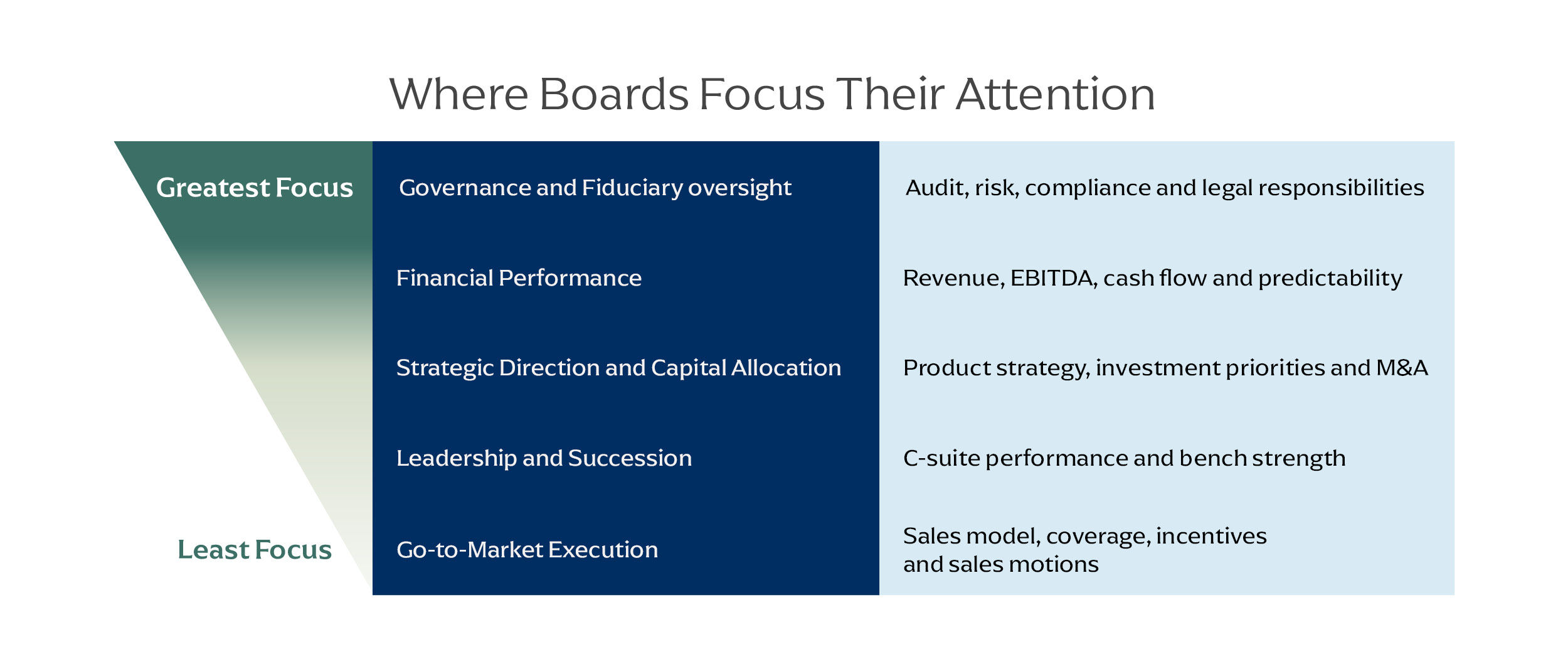
In our research, we found that a board’s involvement in GTM is highly correlated to their confidence in the commercial leadership team. In the case of CEOs and CROs, the level of board engagement is less a reflection of how important GTM is and more a reflection of how credible leadership appears in managing it. When credibility is high, boards become highly deferential. Autonomy expands, and oversight narrows to outcomes instead of decisions.
Board intervention tends to occur only when performance substantially misses expectations or when leaders cannot clearly articulate the rationale behind commercial decisions. Importantly, GTM autonomy is earned, not granted. Executives who consistently translate strategy into outcomes and learnings build permission to operate with a reduced need for board intervention.
How Boards Influence GTM and What That Means for CEOs and CROs
When boards shape GTM strategy, they do so through leadership decisions rather than direct involvement in execution and with succession planning as the primary mechanism. The most impactful GTM choices boards make sit within how they hire, evaluate and, when necessary, replace commercial leaders. Simultaneously, how they define the leadership profile required for the company’s next stage is also important. Succession discussions force boards to confront core GTM realities around whether the business needs growth acceleration or greater operational or financial discipline, for instance.
High-performing boards treat succession planning as a continuous process, not a reactive response to underperformance. With CEOs and CROs, this means credibility is reinforced through the deliberate development and exposure of future commercial leaders to the board. This builds confidence in GTM judgment well before transitions are required. At the same time, boards remain prepared to act decisively when leadership is misaligned with performance expectations. This is done by using hiring and firing to reset direction without redesigning GTM from the boardroom. In combination, leadership decisions and outcomebased expectations allow boards to shape GTM success while preserving executive accountability for execution.
Why This Still Matters: The Hidden Ways Boards Shape GTM Success
Tone at the Top: What Customer Centricity Signals to the Board
While boards rarely debate GTM mechanics, they are becoming more vocal about customer orientation. As an executive, it is critical to demonstrate to the board:
- A clear understanding of buyer needs
- Evidence that decisions are informed by customer impact
To boards, customer-centricity functions less as an operating principle and more as a governance signal. Directors view sustained customer focus as evidence that growth is repeatable, defensible and less dependent on short-term commercial pressure. When customer considerations disappear from management narratives, boards often interpret that as a warning sign, even if topline performance remains strong.
This subtly shifts GTM conversations from narrow discussions of sales productivity to broader conversations about value delivery and long‑term growth durability. For CROs, this is familiar ground. For boards, it is relatively new.
Importantly, customer-centricity functions as a proxy for growth confidence. Even product‑centric organizations face the same underlying expectation that leaders must connect commercial choices to sustainable demand creation.
Best Practices: Working Effectively with High-Performing Boards
#1: Intentional Boards Support Executive Leadership
High-performing boards create GTM leverage by hiring the right leader, setting a clear mandate, and being disciplined about when they engage. For CEOs and CROs, make sure that day-to-day execution remains firmly with management. Board involvement should be concentrated at moments when strategy shifts, disruptions challenge incumbents or the organization requires alignment from the top
During these inflection points, visible board support provides air cover for leadership to move decisively through resistance, without the board attempting to redesign GTM from the boardroom.
#2: GTM Governance Requires Financial Translation, Not Narratives
Boards do not engage through GTM “stories” unless those narratives are grounded in data and clearly tied to performance outcomes. Anecdotes about customer conversations, rep activity or field momentum are insufficient on their own. Without a fact-based tie to growth and profitability, they remain non-actionable and stay as just that: stories.
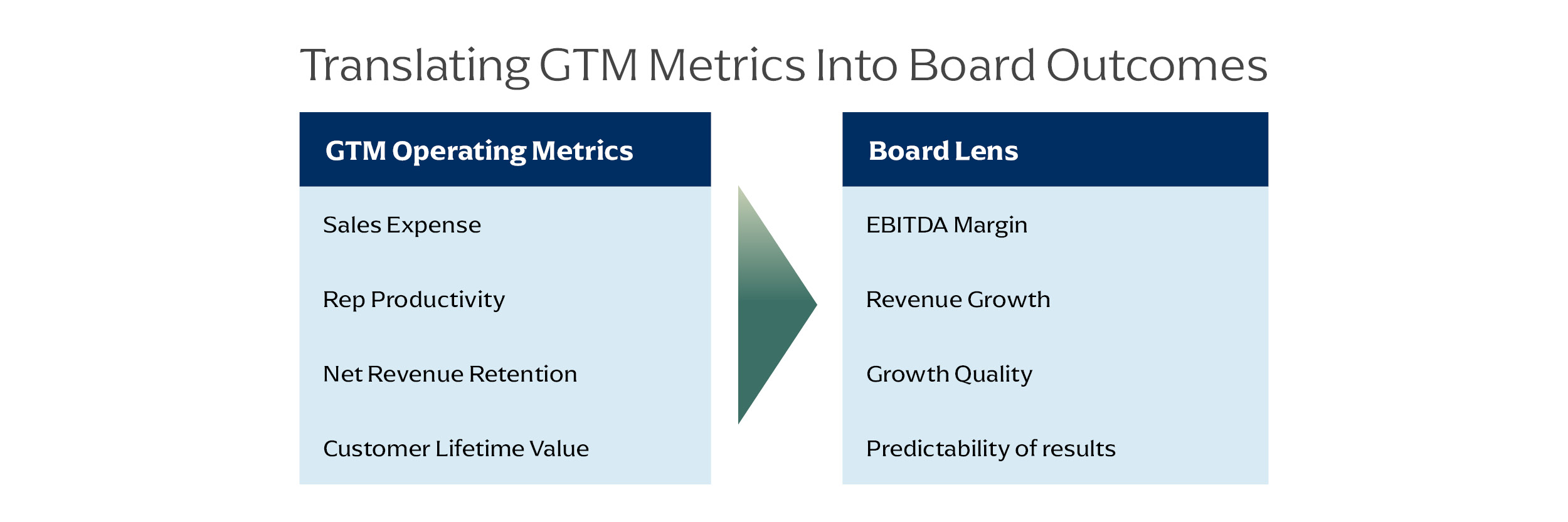
Even when direct attribution is complex, effective CEOs and CROs anchor every GTM discussion in an explicit economic frame. Rather than describing what changed in customer engagement, sales roles or coverage models, they focus on how those changes are expected to drive incremental, durable and profitable growth. They support their case with data-backed indicators, financial logic and clearly defined success metrics.
Credibility strengthens when leaders translate GTM decisions into measurable financial signals and position iteration as disciplined learning, not experimentation without accountability.
#3: Leverage Board Member Expertise
High-performing CEOs and CROs recognize the value in building relationships with board members outside the boardroom, creating opportunities to tap into individual expertise ahead of critical decisions or inflection points. These informal touchpoints allow executives to pressure-test thinking, refine messaging and align on expectations before issues become visible at the full board level.
When done well, this shifts board relationships from reactive oversight to informed guidance. Instead of introducing fully formed recommendations in a high-stakes setting, leaders bring board members along as part of the journey. That way, leaders are strengthening alignment and accelerating decision-making when it matters most.