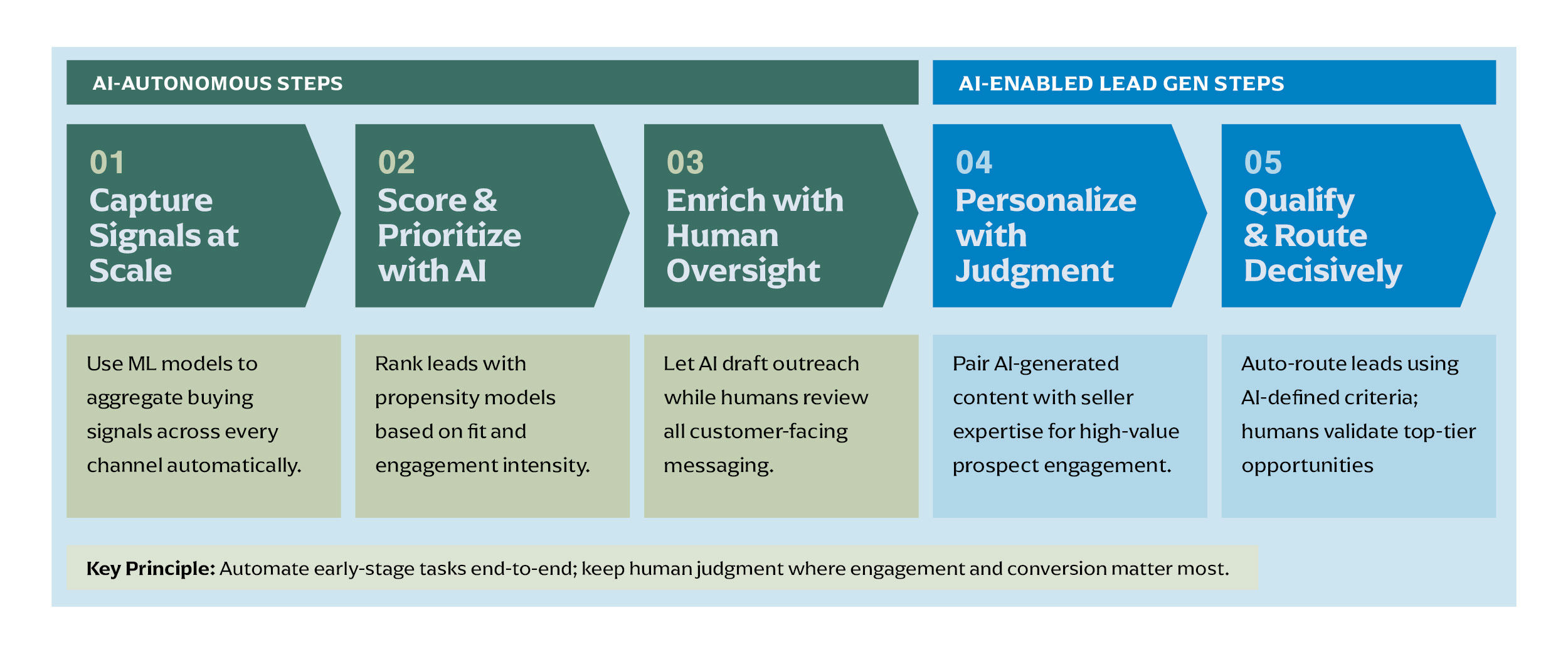
This process shows exactly where AI creates value and where it fails to produce results. AI accelerates background work, so reps are not bottlenecked by preparation and administrative tasks. That way, human involvement stays focused on qualification, nurture and handoff. These are the three areas where judgment and trust shape outcomes. Alexander Group research shows this process represents the target state that high-performing organizations are designing towards. As a result, the role becomes more focused. Reps spend less time preparing to engage and more time advancing opportunities.
The companies seeing results are going beyond just asking how much work AI can replace. They are deciding, step by step, how AI should support the process and then redesigning the role around the moments where human judgment still changes the outcome.
Diverging Paths for Inbound and Outbound Motions
AI is not affecting all lead generation work equally. In fact, it’s splitting the role into two very different motions.
Inbound lead generation is becoming an AI-led workflow. Once a buyer raises a hand, the work follows clear rules: interpret intent, enrich the lead, validate fit and route to a seller. AI agents can perform these steps faster and more consistently than humans, with limited oversight for exceptions.
Simultaneously, outbound is moving in the opposite direction. Without buyer intent, generating interest requires judgment, relevance and persistence. These aren’t tasks AI can fully automate. To address this, companies are concentrating human effort in outbound roles, where reps use AI to remove preparation work but still own the interaction itself. The job moves from maximizing activity volume to creating pipeline quality.
Reps themselves recognize this change. Over 40% of high‑AI‑usage lead generation reps expect prospect discovery to be fully automated within the next few years, while nearly half expect account planning to become AI‑led with human review. Because AI can absorb preparation and administration, outbound reps can manage broader account portfolios without sacrificing relevance.
To fully take advantage of AI lead generation investments, organizations should first map inbound and outbound as distinct motions within the sales process. From there, leaders can determine where AI should operate autonomously to remove friction and where it should enable humans to perform better. After clarifying this, the next step is to redesign the lead generation role so that its activities, skills and bandwidth align with how each motion generates pipeline.
How to Redesign the Lead Generation Role
AI expands usable bandwidth in the lead generation role, but it doesn’t redesign the job by itself. While AI removes time-consuming preparation and administrative friction, AI only creates value when leaders redirect the time it frees up. When redesigning, leaders must make challenging decisions on where human effort now creates the most value.
That’s why a deliberate redesign is essential for turning this shift into a measurable impact. To do this, leaders must make five key decisions to move from traditional lead generation roles to AI-enabled ones:
Decision 1: Redefine the purpose of the role
Traditional lead gen roles are defined by generating customer activity and setting meetings. In AI-enabled models, the purpose must shift to creating a quality pipeline by applying judgment and building credibility. That definition becomes the anchor for what stays in the role and what gets removed.
Decision 2: Re‑scope the job by removing autonomous work
Leaders should explicitly map the role’s activities and decide which ones AI owns end-to-end (e.g., scoring, prioritization, enrichment, routing support) versus which require human ownership (e.g., qualification nuance, credibility‑building outreach, sustained nurture, seller coordination). By reallocating responsibilities, leaders can remove routine activities from the human job and shift time toward high-value activities like engaging customers.
Decision 3: Reallocate bandwidth to the work that creates value
Once AI absorbs preparation and administration, leaders must decide how this reclaimed time gets reinvested. High-performing redesigns dedicate time toward deeper qualification, more relevant outreach, sustained nurture of priority accounts and tighter coordination with sellers during account entry and handoff. Without an explicit reallocation plan, capacity gains will get consumed by confusion among reps.
Decision 4: Reset success measures
Redesign only sticks when metrics reinforce the new job. Activity volume may still matter, but it can’t be the primary signal of performance. To adapt, expectations should move toward pipeline quality, seller-validated handoffs and conversion outcomes.
Decision 5: Update the talent profile and enable it
As the role becomes more judgment-led and relationship-driven, the skill profile changes. AI-enabled lead gen reps need stronger business acumen, message discipline and collaboration with sellers. Leaders should codify these skills, adjust hiring and coaching, and ensure reps know exactly how AI is expected to support their daily workflow.