Skip to Main Content
Article

Buyers Are Not Resisting AI. They Are Resisting Bad AI Experiences.

AI adoption across commercial organizations is widespread. Sales, marketing and service teams are investing aggressively in co-pilots, agents, self-service tools and workflow automation. Yet, buyer confidence hasn’t kept pace.

For large B2B commercial organizations operating at scale, this tension is especially pronounced. As commercial teams accelerate AI investment, enterprise buyers are becoming more selective about where and how those tools appear in the buyer journey. Buyers aren’t outright rejecting AI, but they are reacting to AI that removes trust, context or control from the process.

This buyer response is already showing up in purchasing behavior. Recent Alexander Group research shows that 42% of buyers have slowed, modified or stopped purchases due to concerns around AI. Essentially, buyers are unwilling to tolerate AI experiences that feel generic, opaque or ill-suited to the moment.

The core buyer message is simple. Automate friction, not relationships.

Intelligent vs. Autonomous AI: A Critical Distinction for GTM Leaders

Not all commercial AI investments affect buyers in the same way. Across organizations, AI-driven sales capabilities generally fall into one of two categories: intelligent sales and autonomous sales.

Intelligent sales works behind the scenes by equipping sellers with insights, recommendations, preparation and guidance without directly engaging the buyer. This includes tools such as coaching and guidance, sales intelligence, lead enrichment and churn reduction.

On the other hand, autonomous sales engages buyers directly through automation, self-service, chat and agent-led interactions. Tools used during this process can include AI SDRs, inbound automation and service agents.

These approaches create very different buyer experiences. Intelligent AI carries lower experience risk and higher buyer acceptance because it improves seller effectiveness without changing the nature of the buyer relationship. Autonomous AI introduces both opportunity and risk. While it can improve speed and scalability, it can also weaken trust if it shows up at the wrong moment or doesn’t have enough context.

This reflects the underlying reality of complex B2B buying. As one private equity operating partner put it, “Most buying activity still happens because of people and relationships, not just process. There’s still a very real human element to selling.”

That insight reflects why most organizations start using intelligent AI internally first. With intelligent AI, companies can refine accuracy, governance and role fit before moving those capabilities closer to the customer. Think sales intelligence tools or internal knowledge bases that sharpen seller performance before any buyer interaction occurs. But as AI advances, more tools are becoming customer-facing. At that point, the buyer experience becomes the deciding factor rather than technical readiness alone.

Buyers are signaling caution, not resistance. 74% prefer a balanced or human-led mix of AI tools.

Close

Where Autonomous AI Improves the Buyer Experience

Buyers are clear about where autonomous AI adds value. It performs best when the interaction is simple, low-risk and time-sensitive.

In these moments, autonomy improves the experience by removing friction. AI can compress timelines, answer questions instantly, make options easier to compare and reduce the effort required to move forward. Instead of viewing this as a replacement for expertise, buyers see it as improving access.

Survey responses reinforce that pattern. Buyers primarily use AI to reduce waiting time and effort:

  • 67% need a quick answer without waiting on hold
  • 62% value 24/7 availability
  • 52% want easier comparisons or configurations
  • 47% say the task is simple and does not require a person

These are low‑stakes, transactional touchpoints. When handled well, autonomous AI removes friction from the experience without diminishing trust or personalization. In these parts of the journey, autonomy is not threatening. It is helpful.

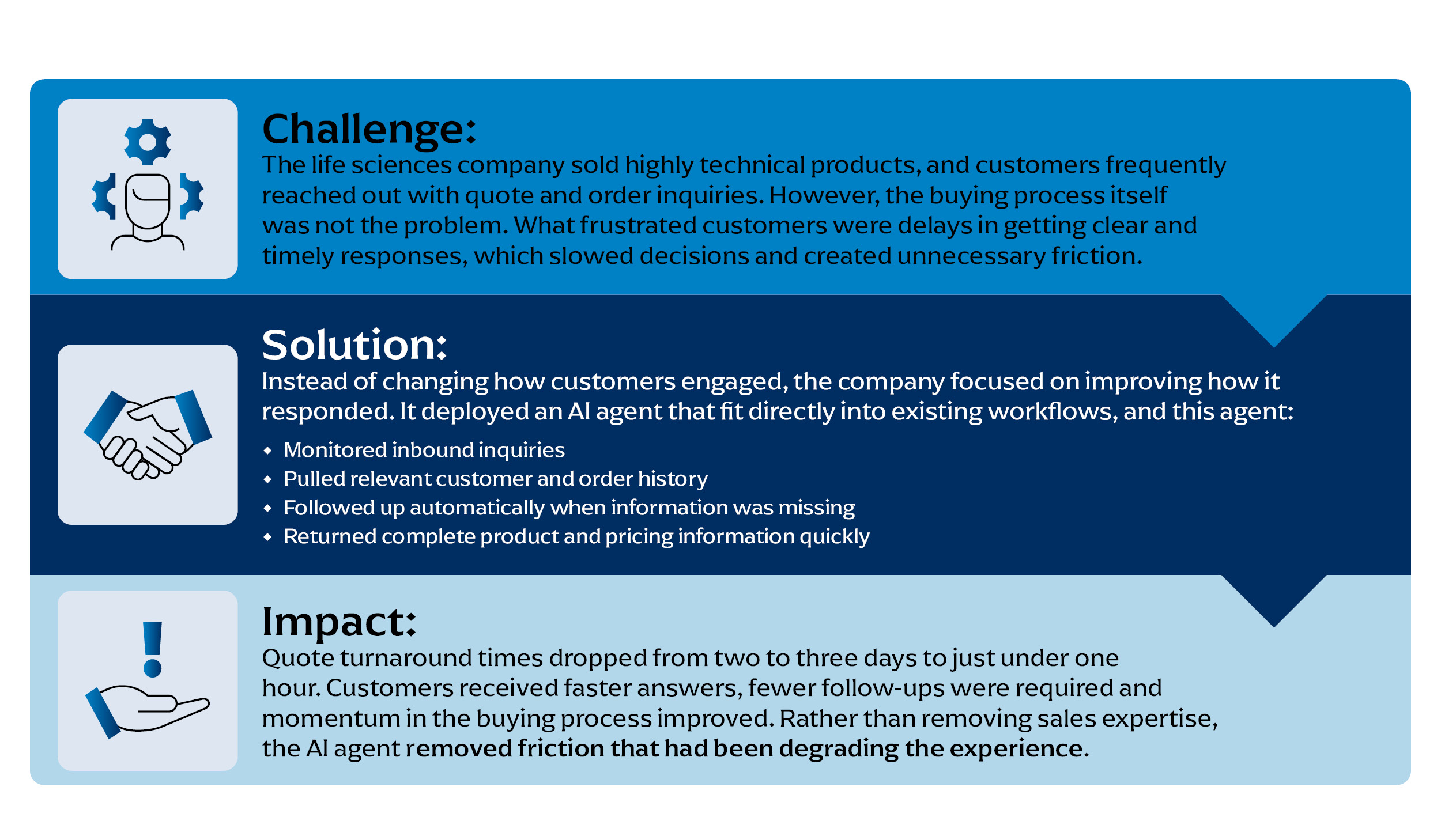
A life sciences company illustrates how customer-facing AI can improve experience when designed correctly.

This case study reflects a broader principle voiced by buyers and commercial leaders alike. As one commercial operations leader explained, “I would not have the customer change anything about the way that they are coming to us. What I would change is the way that we are responding to the customer.

That is the right lens for customer-facing AI. Design for adoption, not novelty. Autonomous AI succeeds when it reduces effort, preserves familiar workflows and makes it easier for customers to get what they need. Ease of use and alignment with the buyer experience matters far more than the sophistication of the model behind the scenes.

Where Autonomous AI Breaks the Experience

Autonomy becomes a liability when interaction requires judgment, nuance or trust.

These are the moments that define enterprise sales outcomes. Buyers expect human accountability when requirements are ambiguous, stakes are high or the conversation affects risk, price or long-term commitment. When AI attempts to replace that judgment, it often does the opposite of what it was intended to do. AI slows decisions, increases skepticism and reintroduces friction elsewhere in the journey.

Buyers are clear on where today’s autonomous AI still falls short:

  • 66% cite challenges building trust and rapport
  • 58% say AI struggles to understand complex or unique requirements
  • 53% say AI falls short in negotiating price and terms

They are some of the most consequential interactions in enterprise selling.

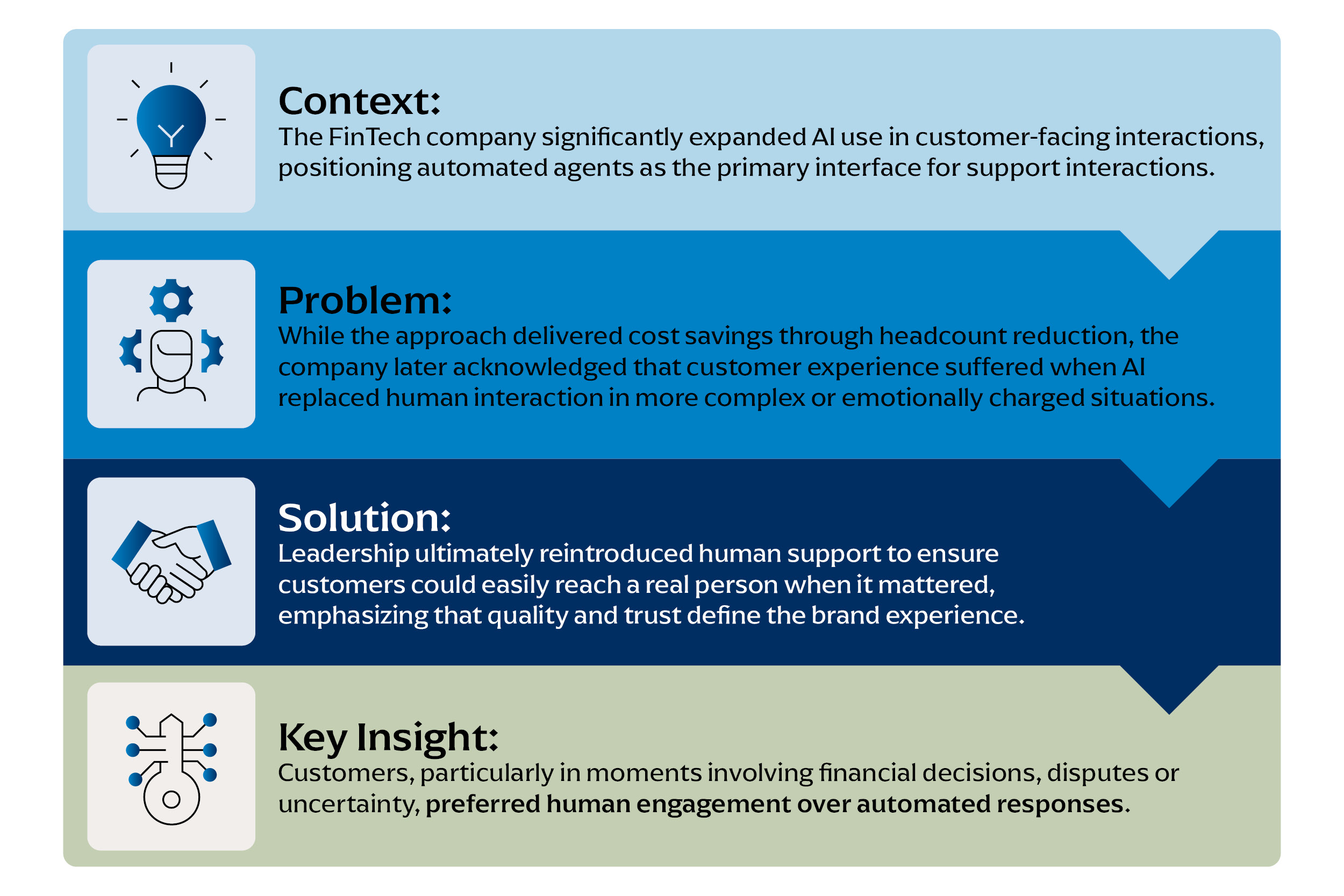
A large FinTech company unveils how autonomy can break the experience when applied too broadly.

This is why over-automation is such a common failure mode. Organizations that try to automate everything end up diluting effectiveness and increasing risk. AI performs best when applied selectively to high-impact, repeatable tasks instead of relationship-driven moments where buyers still want judgment, interpretation and commitment.

The Brand Risk of Poor AI Execution

In customer-facing sales motions, AI does not just create an experience risk. It creates credibility and data security risk with clients.

When AI outputs feel generic, inaccurate or disconnected from the customer’s business, buyers don’t see innovation. They see weak judgment. This perception undermines confidence in the seller, the offering and the company behind it. In enterprise environments, where trust is part of the value proposition, poor AI execution can quickly damage brand credibility.

The risk becomes even greater when buyers question how their data is being used. If customers do not understand what data AI can access, how it is being used or what safeguards are in place, the solution can quickly shift from efficiency enabler to security concern. At that point, the issue has moved away from usability and towards declining client trust.

52% percent of buyers want a clear explanation of where and how AI is used.

All of this means that transparency is now a commercial requirement. Buyers expect clear explanations of where AI is applied, what information supports it and how customer data is protected. If those answers are vague, confidence drops quickly.

In many cases, poor AI execution is worse than no AI at all. A generic experience weakens credibility, a careless one creates perceived data risk and both slow deals while raising the cost of trust.

The Future Buyer Experience Is Intentionally Hybrid

Buyers are not asking for fewer humans. They are asking for better interactions.

As a result, intelligent AI has the strongest long-term role. It succeeds when it absorbs preparation, analysis and complexity so sellers can focus on judgment, strategy and trust. Eliminating human involvement is not the goal. The goal is to make those moments more valuable.

Across the buyer journey, research notes this as a consistent expectation. Over the next 18 to 36 months, buyers expect AI to become more embedded, more capable and more useful. However, they don’t expect it to become more autonomous by default.

What buyers do want is targeted improvement:

  • 60% expect automated evaluation of technical or regulatory requirements
  • 58% want fewer but higher-quality human interactions
  • 53% want faster access to tailored information

That second point is especially important. Instead of viewing progress as full automation, buyers are defining it as higher-quality engagement.

Sellers remain critical for strategic guidance, interpretation, negotiation and commitment. AI may reduce the cost of preparation and increase the speed of information access, but it does not remove the need for confidence-building human interaction.

What This Means for Commercial Leaders

The ultimate takeaway shouldn’t be to slow down AI investment. Instead, commercial leaders should focus on being more deliberate about where and how AI shows up in the buyer experience. Buyers want AI to accelerate access to tailored insights and comparisons; improve pricing accuracy and ROI modeling; reduce unnecessary effort and waiting; provide clear escalation paths to humans; and support hybrid buying models that preserve trust.

The companies that win will be the ones that design AI most intentionally. That means applying autonomy where it removes friction and preserving human judgment where it creates confidence. AI will not fail in sales because the technology is immature. When organizations automate faster than buyers can trust, that’s when AI will fail.

For commercial leaders, the defining question to ask is whether each use case strengthens, or at the very least maintains, the buyer experience.

Don’t Let AI Adoption Put Buyer Confidence and Brand Reputation at Risk

Alexander Group’s Advanced Analytics practice works with commercial organizations on designing that fits intentionally into the buyer journey to accelerate access while safeguarding confidence and reputation.

Back to Top