Skip to Main Content
Article

How AI Is Forcing GTM Leaders to Rethink Customer-Facing Jobs

Why GTM AI advantage will come from innovative job design.

Across commercial organizations, which include marketing, sales and service teams, AI has moved quickly from experimentation to expectation for customer-facing jobs. Most go-to-market (GTM) teams can tell you what tools they’ve bought: sales copilots, conversation intelligence platforms, service chatbots. However, now executives want to know how AI is growing the business, not what tools teams are deploying.

Alexander Group’s AI research found that only 50% of companies implementing AI solutions achieved positive ROI within 12 months. Even as the number of tools in use continues to grow, gains are incremental, adoption varies widely and customer-facing jobs still look largely the same. The lack of progress is increasingly a strategic problem, not a temporary rollout issue.

Rather than an execution issue, the gap between AI investment and business impact is a design issue. A consistent pattern has emerged across Alexander Group’s years of research, benchmarking and GTM transformation work: organizations are investing in AI faster than they are redesigning the jobs expected to use it. As a result, AI is being applied to roles built for yesterday’s operating model—thus limiting the value those tools can ultimately deliver.

Today’s commercial leaders must understand that the most important AI decisions are not technology decisions. They are decisions about how customer-facing jobs should change, including how work is structured, how time is allocated and how performance is measured and rewarded.

Why AI-First Deployment Approaches Fall Short

The dominant approach to incorporating AI into GTM organizations has been practical: relieve administrative burdens to free time for higher-value work. In theory, sellers spend less time on CRM updates and internal coordination and spend more time with customers. The flawed assumption is that task relief automatically translates into higher seller productivity. However, this is not how it typically plays out in complex B2B environments.

In practice, tool‑first deployments tend to fail in predictable ways. During interviews, RevOps leaders describe adoption friction when sellers are told to learn yet another tool on top of their already large tech stack. Meanwhile, reps are creating shadow workflows by pasting AI-written outreach into email, then re-entering context into a CRM—canceling out the intended time savings.

AI only delivers value when it reduces workflow complexity, not when it adds to it. If leaders layer activity-level AI into unchanged roles, they’ll create friction, slow adoption and constrain returns.

An Actionable Way to Understand AI’s Impact on GTM Jobs

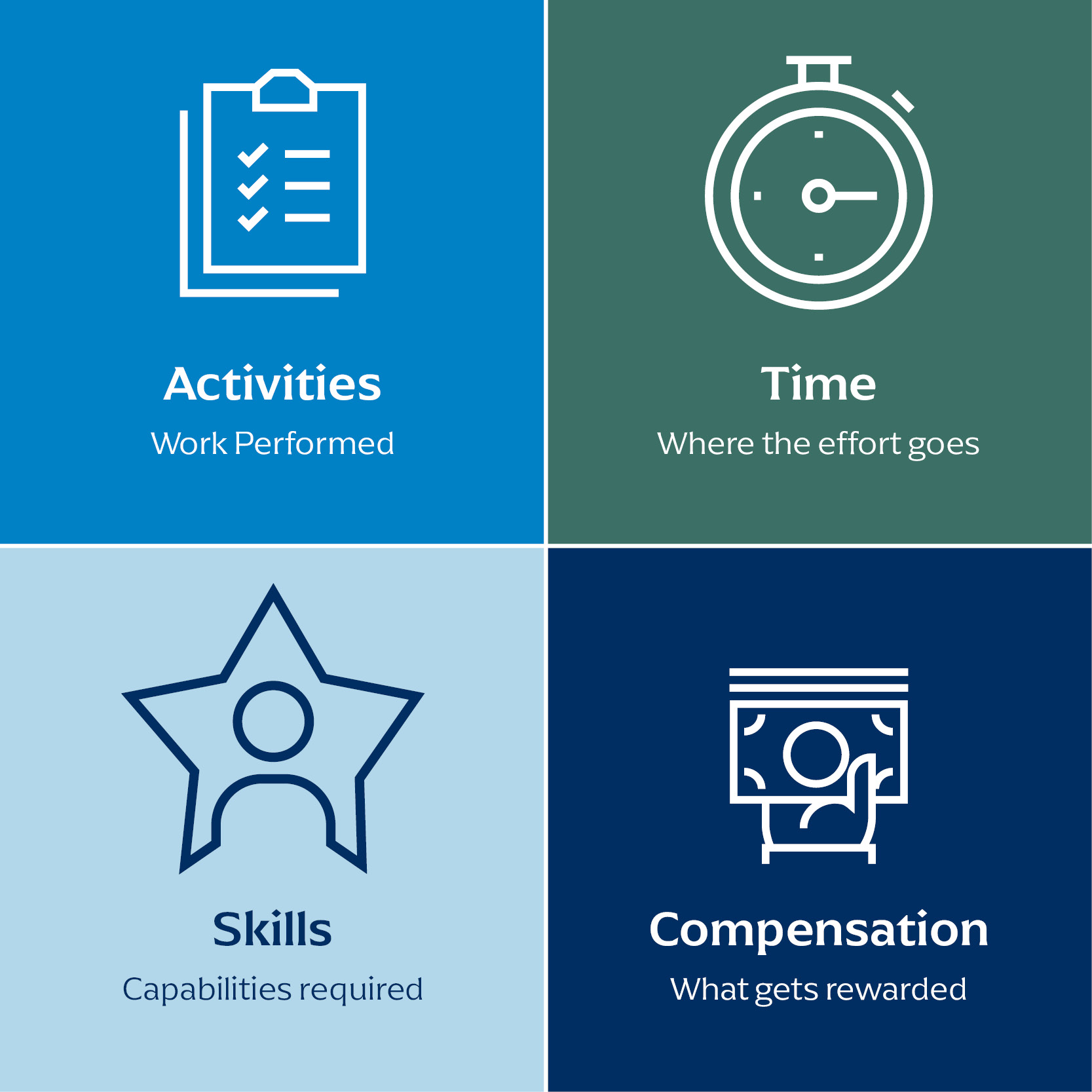
To move from experimentation to advantage, leaders need a more disciplined way to think about how AI reshapes customer-facing work. The most effective lens focuses on four interdependent dimensions of job design: activities, time, skills and compensation.
Close

Activities: AI does not affect all work equally. Some activities can be fully automated. Others are enabled by AI but still require human judgment. The rest may remain largely unchanged. When leaders treat these categories as interchangeable, they make poor investment decisions and unclear role expectations.

Activities in Practice

Lead Gen Rep Before: Lead gen reps manually research and draft outreach.

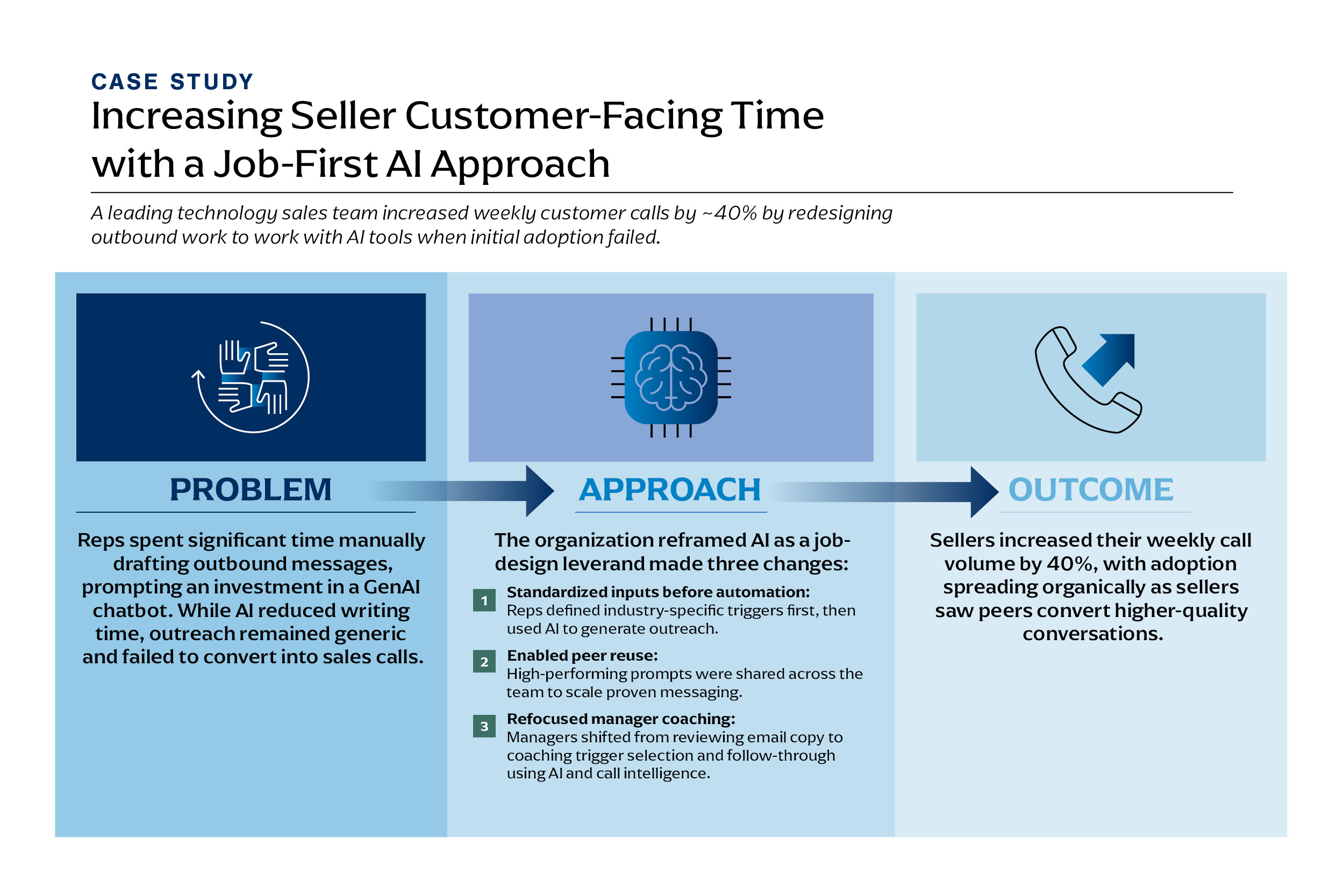
After: AI generates trigger‑ and industry‑specific sequences, and reps focus on selecting triggers, validating relevance and improving hold rates.

Support Rep Before: Support teams handle routine and complex cases.

After: Agents handle Tier 2 and Tier 3 issues, while humans focus on Tier 1 escalations and “white glove” exceptions.

Time: If activities change, then the time spent on activities should also change. AI enables faster execution of the same work and frees capacity for higher-value activities. Without intentional time shifts, efficiency gains are absorbed rather than reinvested.

Time in Practice

Enterprise Segment Seller Before: Rep spends 10–20 hours per month diving deep into account research and discovery for a single customer.

After: Rep prompts AI chat tools to scan and summarize relevant account, deal and customer data 10 minutes before a sales call.

Mid-Market Segment Seller Before: Rep spends 30 minutes before and after each customer call preparing pitch materials and documenting next steps, limiting them to 2–3 calls per day.

After: Rep uses AI prompts to prepare for meetings and generate follow‑up materials, enabling 5–6 customer calls per day.

Skills: AI changes what “good” looks like in the role, causing certain capabilities to become less critical. Subsequently, others—including judgment, relationship management and coaching—are becoming more important. New skills related to overseeing AI-enabled workflows and interpreting AI-driven insights are also emerging. Firms that don’t explicitly manage skill evolution struggle to translate technology improvements into performance gains.

Skills in Practice

Lead Gen Rep Before: Effectiveness depends on writing strong outbound emails and manually researching accounts and personas.

After: Effectiveness depends on selecting the right signals, prompting AI effectively and judging which AI‑generated outreach is relevant enough to send.

Seller Before: Value comes from preparation effort, product knowledge recall and manual creation of decks and follow‑ups.

After: Value shifts to discovery quality, deal strategy and the ability to interpret, refine and act on AI‑generated insights during live customer conversations.

Sales Compensation. Just as AI reshapes these other dimensions, compensation design must move with the redesigned job. Incentive plans built around legacy measures can unintentionally discourage reps from adopting AI-enabled ways of working. Effective compensation design reinforces the behaviors and outcomes AI is intended to enable—ensuring that roles, incentives and performance expectations move together rather than in opposition.

Compensation in Practice

Support Rep Before: Incentives prioritize handle time and ticket volume, regardless of issue complexity.

After: Incentives emphasize resolution quality, customer outcomes and effective escalation, reflecting AI’s role in absorbing routine interactions.

Seller Before: Compensation assumes legacy capacity and rewards broad activity proxies alongside revenue.

After: Compensation assumes AI-enabled capacity, with higher expectations for deal quality, multithreading and execution against defined sales motions.

These dimensions reinforce one another. Addressed together, they create structural change. Addressed independently or not at all, AI initiatives struggle to move beyond pilots.

Rebalancing Job Bandwidth in the AI Era

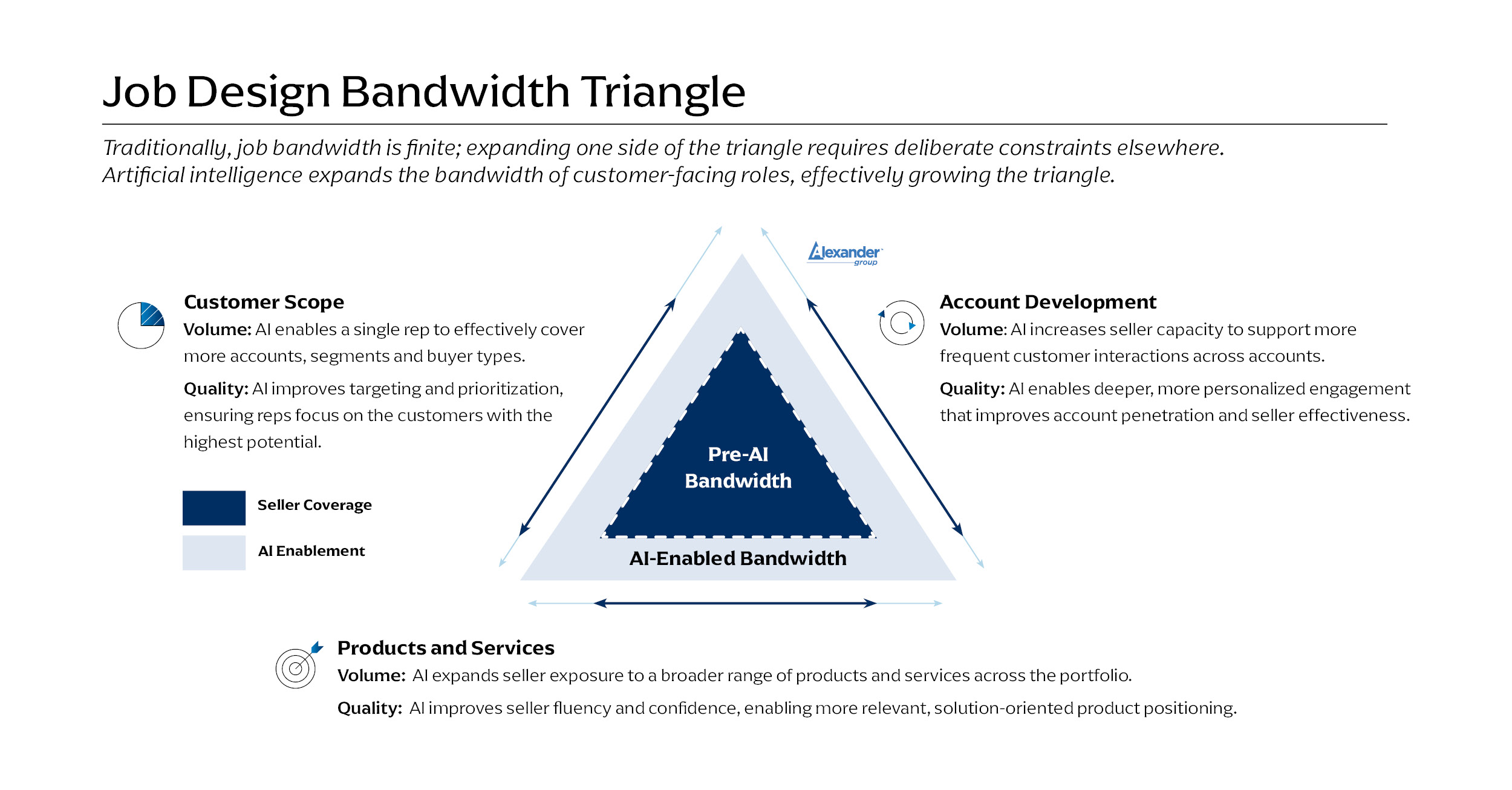
While activities, time, skills and compensation explain what changes when AI enters customer‑facing roles, job bandwidth explains how much those roles can realistically absorb.

Every customer‑facing job operates within constraints across three dimensions: customer scope, account development and product and service scope. Together, these dimensions form the Job Bandwidth Triangle. Traditionally, that bandwidth was finite: expanding one dimension of the triangle requires deliberate constraints elsewhere.

AI creates incremental capacity by automating, accelerating or simplifying execution-heavy work that previously consumed large portions of a role’s bandwidth.

However, this expanded capacity is not uniform, and it is not unlimited. AI expands different sides of the bandwidth triangle for different roles, depending on where execution burden is reduced and where human judgment remains essential. AI’s value doesn’t come from expanding every dimension simultaneously, but from intentionally reinvesting newly created capacity in the dimensions that drive the greatest business impact for each role.

How AI Expands Job Bandwidth: Volume and Quality Impacts by Role

Role Customer Scope Account Development Product and Service Scope
Lead Generation ·Increases the number of accounts and personas engaged

·Improves relevance by prioritizing AI-identified signals

·Increases the volume of live outreach and follow-ups

·Improves qualification efficacy through better timing and focus

·Increases access to surface-level product context

·Improves message accuracy without expanding role complexity

Generalist Sales ·Selectively increases the number of accounts managed

·Improves prioritization using AI-driven insights

·Increases time spent in active deal engagement

·Improves deal quality through deeper strategy and multithreading

·Increases availability of product and pricing insights

·Improves application of knowledge through human judgment

Customer Support/ Service ·Increases the number of customers supported

·Improves focus on high-impact customer needs

·Increases capacity for escalations and exceptions

·Improves resolution quality and customer outcomes

·Increases access to historical and contextual information

·Improves consistency of recommendations without specialization

Leaders first use the four dimensions of activities, time, skills and compensation to redesign the role. Then, they use the bandwidth triangle to decide what expands and what stays constrained by aligning the job design to the highest value activities.

Design with AI in Mind

The organizations that capture the greatest value from AI are those that (re)design roles with clear decisions around what scales and what stays constrained.

In the articles that follow, we will examine how these dynamics play out across pre-sales, sales and post-sales jobs. The specifics differ by motion, but the conclusion is consistent.

AI is not a productivity feature. It is a forcing function for modern GTM job design. Start by choosing which dimension of bandwidth you will expand, then redesign the role to reinforce that choice. Leaders who recognize that distinction are better positioned to drive sustained, profitable growth.

Ensure GTM Jobs are Aligned with AI Adoption and Deployment

By scheduling time to speak with Alexander Group’s Analytics & Research practice, you’ll be better informed on what job design issues are hindering AI adoption at your organization—and the best path forward to unlock performance gains.

Back to Top