Skip to Main Content
Technology

Stop Overpaying for Growth: The Expansion-First Playbook

Explore four strategies that leading tech CMOs are using to reduce CAC by 30-40%

Part 3 of 3 in “The CAC Reckoning” series

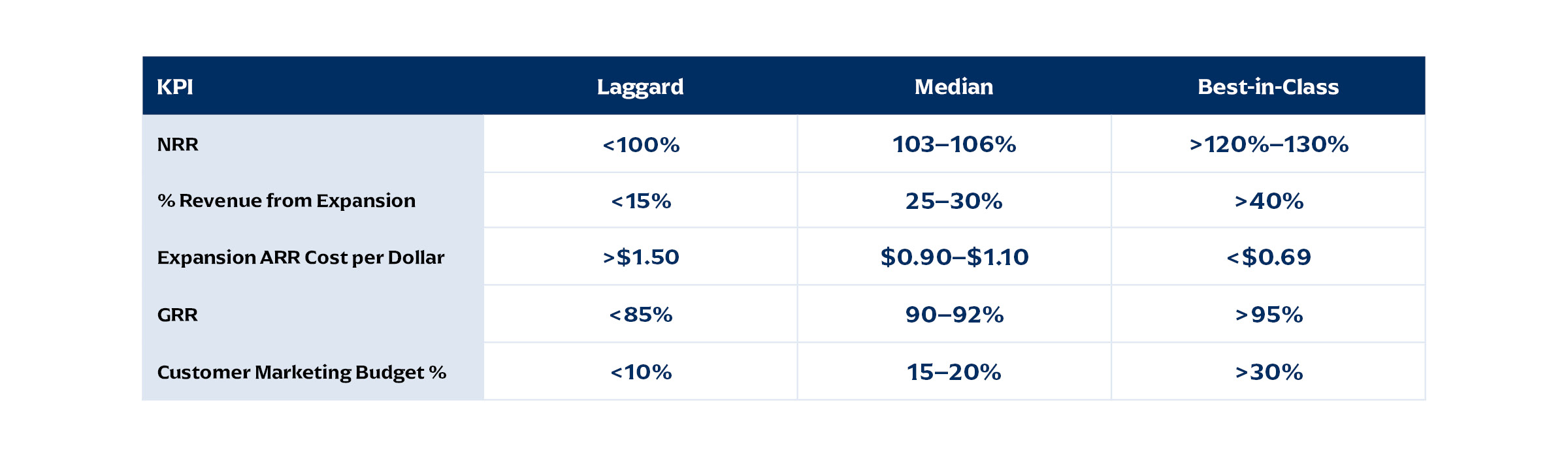
In Part 1, we established the problem: Combined sales and marketing customer acquisition cost (CAC) has surged to $2 per dollar of new ARR, and most CMOs don’t even know their real number. In Part 2, we proved that expansion revenue costs between $0.20 and $0.69 per dollar versus around $1.50 to $3 for new logos—a capital efficiency advantage that compounds every quarter.

Now, it’s time for the playbook.

Drawing from Alexander Group’s work with hundreds of technology companies, experts have compiled four recommended strategies to produce measurable results.

Strategy 1: Move from New Logo Addiction to Expansion Economics

The Problem

Most technology marketing organizations still route 70%–85% of budget to new logo acquisition, the motion that now drives about half of ARR growth at 3–10× the cost of expansion. That split made sense when new logos led growth. It no longer does.

The Recommended Strategy

Restructure the commercial model so that renewals and expansion become the primary growth engine, not a secondary motion:

Deliberately rebalance investment allocation. Move from a 70/30 or 80/20 new-logo/expansion split to 50/50 or even 40/60 for mature install bases. Alexander Group’s research shows that 58% of high-growth organizations are investing in customer journey architect capabilities and 33% are building content strategy capabilities, both of which are essential to systematic expansion.

Restructure compensation to reward retention and expansion. Customer Success (CS) and Sales jointly own expansion quotas, while leadership bonuses are explicitly tied to GRR/NRR. When the compensation structure signals that expansion matters as much as new logos, behavior changes across the entire organization.

Build cross-functional “Save and Expand” squads. Sales, CS, Product and RevOps share a single view of health, risk and opportunity. Quarterly campaigns focus on specific at-risk or expansion-ready cohorts. Value reviews are tied to hard ROI instead of just product usage.

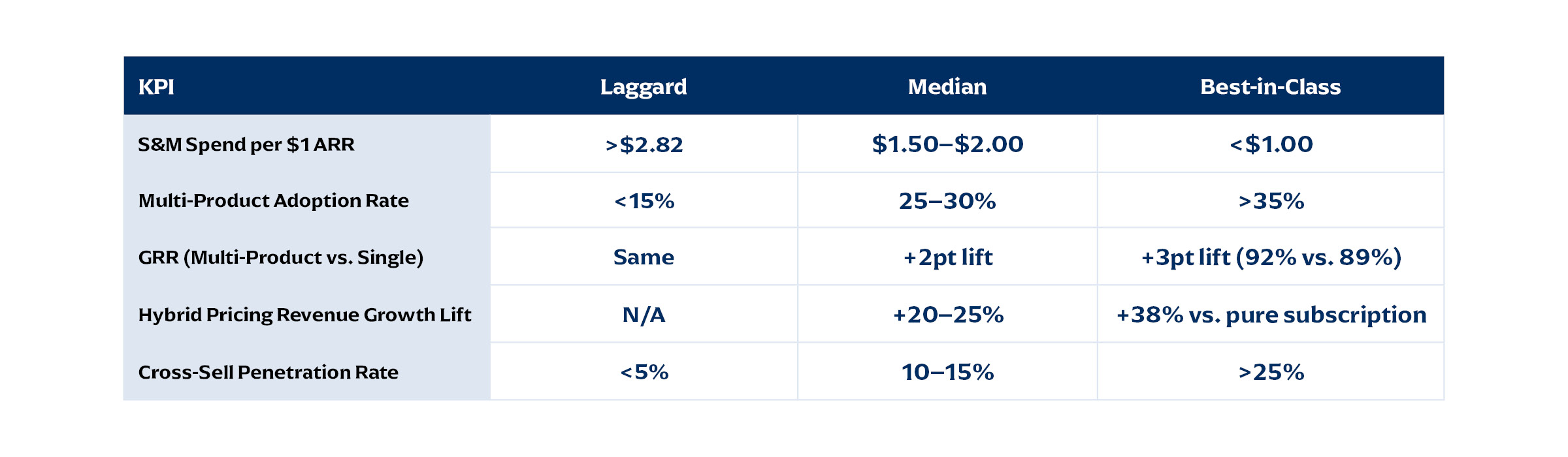
Invest in multi-product adoption. Alexander Group’s benchmarking shows that customers who adopt integrated suites achieve 92% gross retention versus 89% for single-product users. This is a three-point GRR lift that compounds meaningfully over time and creates natural cross-sell/upsell paths.

Close

Strategy 2: Modernize the Demand Center and Rationalize CAC

The Problem

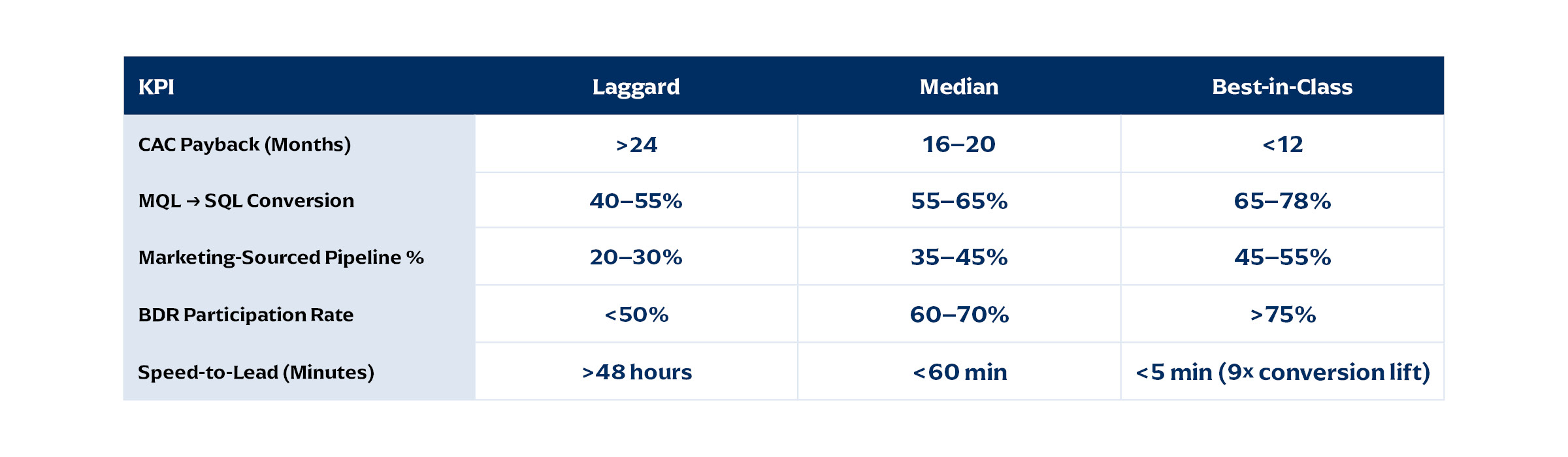
Most technology organizations still run BDR/SDR teams under sales with subjective qualification, producing a 30%–50% MQL bleed rate and rising CAC. Alexander Group research puts output at 3.6 quality conversations per 94 daily touches, down 45% since 2014. The outbound model is in structural decline.

The Recommended Strategy

Consolidate fragmented BDR/SDR functions under marketing into a modern demand center, with AI-powered lead scoring, ideal customer profiling and agentic workflows:

Centralize business development under marketing. Create distinct demand center roles with comp plans, standardized lead qualification criteria and ML-based scoring incorporating ICPs and personas. .

Deploy agentic AI applications. AI SDR adoption has surged to 68% among mid-market B2B teams in 2026. Companies deploying AI SDRs report 35%–45% CAC reduction as fixed AI costs replace variable headcount, with pipeline velocity increasing 2.5× and qualified opportunities hitting sales 40% faster. AI-driven personalized campaigns achieve 15%– 25% reply rates, versus 1%–5% baseline cold email.

Implement true blended CAC measurement. Move from channel-level CPLs to fully loaded combined S&M CAC by segment and motion, because measuring the real number means you’re truly optimizing for it.

Design for “terminal velocity.” Set maximum capacity targets based on AI-driven bandwidth expansion and work backward to redefine roles quarterly. Our AI & GTM Job Evolution research found that AI power users are expanding capacity across all three dimensions by delivering 18% more customer calls, covering 19% more accounts and closing 23% larger deals.
Strategy 3: Surgical Pricing, Packaging and Demand Protection

The Problem

AI now allows buyers build in-house what they used to buy as SaaS. The market is already repricing: Pure per-seat models fell from 21% to 15% of vendors in 12 months, while hybrid subscription-plus-usage surged from 27% to 41%. When buyers can build most of a product’s functionality with AI agents and low-code platforms, feature selling is dead and marketing shifts from demand generation to demand protection.

The Recommended Strategy

Deploy surgical pricing and packaging that creates natural expansion paths while protecting core revenue:

Introduce AI add-ons and usage-based pricing elements. Capture AI-related budget instead of losing it to in-house development. Critical features stay in core plans; AI/value-add features create upsell paths.

Design packaging for cross-sell and upsell acceleration. Define natural expansion triggers (feature usage, growth, needs) and design packaging to encourage multi-product adoption.

Arm sales with build vs. buy battle cards and ROI calculators. Marketing becomes the first line of defense against churn and commoditization. Value-proof frameworks that quantify total cost of building vs. buying are essential at every renewal conversation.

Implement “good/ better/best” tiering with clear expansion paths. Core packages serve as platform entry points, functional bundles are use-case driven and enterprise bundles offer the full platform. Each tier creates a natural path to the next, with defined cross-sell pathways across modules and departments.

Strategy 4: Coverage and Targeting Precision

The Problem

Many technology organizations run the same coverage model for $5,000 SMB accounts and $2 million enterprise deals. Tech generates 45% of pipeline from marketing at a 1.5:1 seller-to-marketer ratio, the highest marketing investment intensity of any industry Alexander Group tracks. That spend demands surgical precision. The ABM case for it is settled, delivering 87% higher ROI than traditional marketing. Yet most programs still fail on list discipline: Engagement lifts 3.4× at tier-1 but collapses to 1.6× once lists pass 200 accounts.

The Recommended Strategy

Deploy risk- and value-based coverage models with surgical ICP targeting and personalized ABX orchestration:

Tier accounts by ARR, risk and expansion potential (not just revenue size). The 2026 ABM Benchmarking Study confirms that leading programs have moved beyond traditional taxonomy to five distinct ABM types: strategic, scenario, segment, programmatic and pursuit marketing. Strategic ABM is used by 84% of programs for existing accounts, while pursuit marketing is deployed by 48% for new business.

Deploy segment-specific marketing budgets and pipeline yield models. Alexander Group’s Marketing Pulse ROI Survey reveals a significant opportunity gap for this: 34.6% of organizations use behavioral and firmographic data to create dynamic segments, while only 14.6% apply predictive models to segment customers based on likelihood to buy or engage.

Build first-party data assets and invest in segmentation frequency. According to our research, 53% of organizations that incorporate new data insights into marketing segmentation at least monthly outperform peers who refresh quarterly or annually.

Leverage ML-based opportunity modeling. Alexander Group’s data science practice deploys machine learning propensity-to-buy models that use firmographics, interaction history and behavioral signals to score accounts.

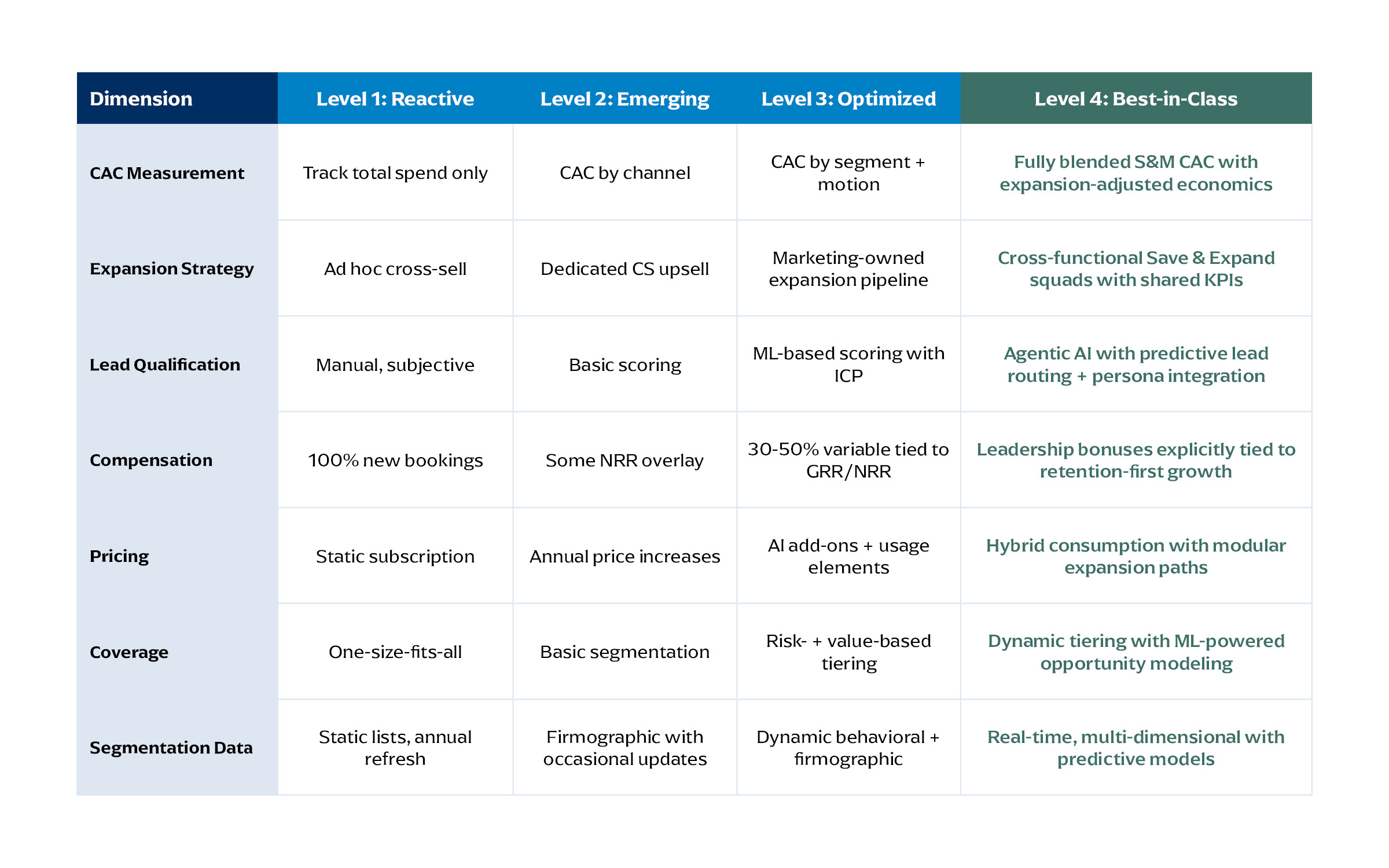
The CAC Mastery Maturity Model

These four strategies don’t operate in isolation. The organizations achieving the most dramatic CAC improvements are executing across all four simultaneously by creating a reinforcing system where expansion economics, demand center modernization, pricing precision and coverage optimization compound each other’s impact.

Where are you today? Where do you need to be?

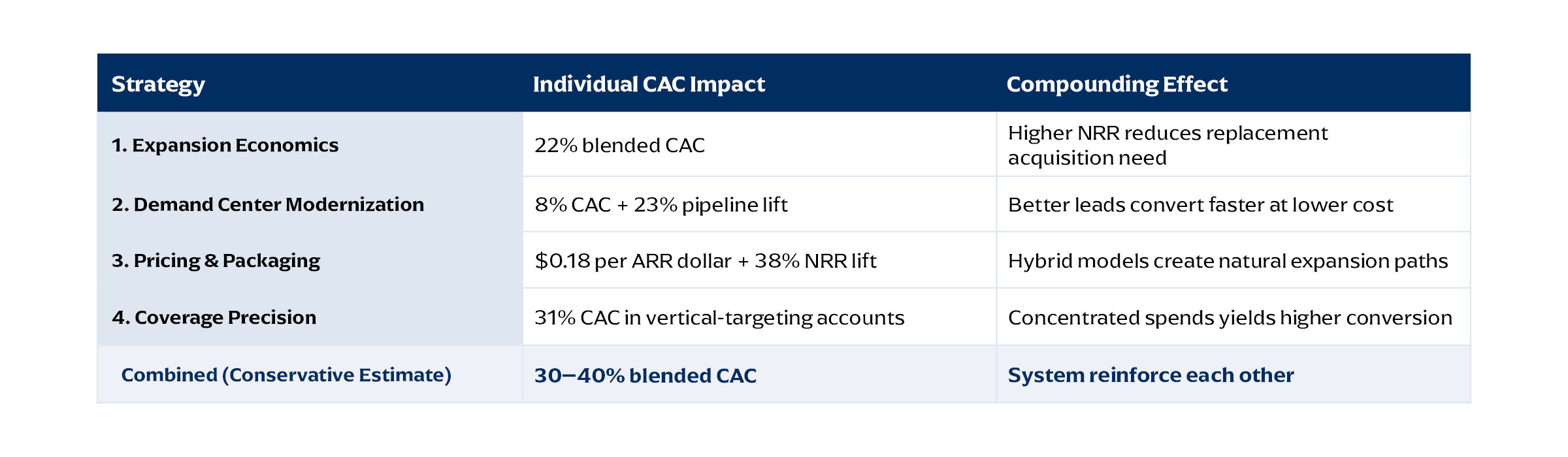
The Compound Effect: What Happens When All Four Strategies Work Together

Consider the aggregate impact when a Technology company executes all four strategies in parallel. These are operating realities for the companies that have committed to architectural transformation.

The Bottom Line

Combined sales and marketing CAC is ballooning, but the playbook for collapsing it exists—and it’s being executed by leading technology CMOs right now.

The four strategies are clear:

  1. Shift investment to expansion economics: Your best pipeline costs $0.69 versus $2
  2. Modernize the demand center: Centralize under marketing, standardize qualification and deploy agentic AI
  3. Deploy surgical pricing and packaging: Hybrid models and AI add-ons that create natural expansion paths
  4. Implement coverage precision: Risk- and value-based tiering with ML-powered segmentation

The companies that execute across all four are achieving 30–40% blended CAC reduction, 120% or above NRR and ten to twelve times the revenue. The companies that don’t are still spending $2.82 for every dollar of new ARR and wondering why the math doesn’t work.

It’s clear that the economics have permanently shifted. Now it’s time to ensure that your commercial architecture moved with them.

This is Part 3 of “The CAC Reckoning,” a three-part series on collapsing combined acquisition costs in Technology & Media.

Part 1: “Your CAC Is Lying to You” → Read Part 1

Part 2: “The $0.69 Pipeline You’re Ignoring” → Read Part 2

Spending $2 to earn every dollar of new ARR?

Connect with Alexander Group and we'll help you rearchitect your commercial model to collapse CAC and shift growth toward expansion economics.

Back to Top