English:
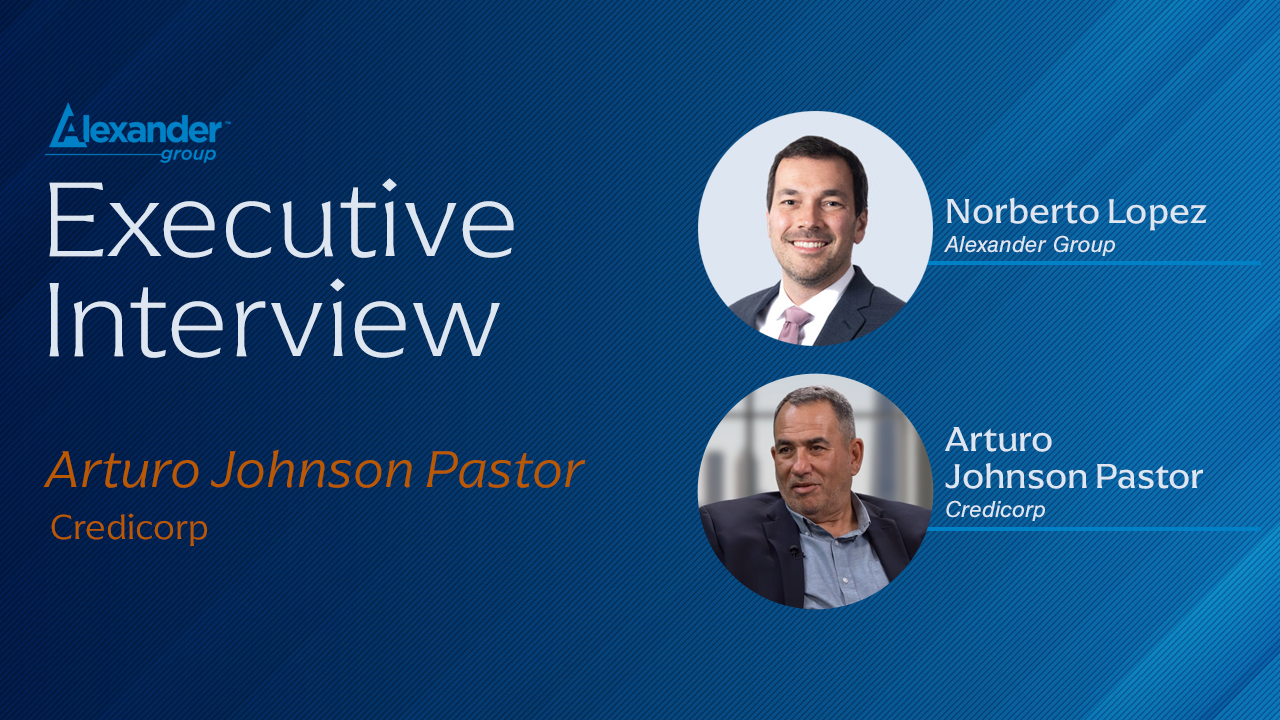
Norberto Lopez: Hello, I am Norberto Lopez, I am responsible for Alexander Group’s presence in Latin America. Today we are going to talk about a transformation in the variable compensation program. I will be joined by three people from Credicorp, starting with Rosella Acosta, who is responsible for the Total Rewards and Performance COE in the organization. Rosella, thank you for being with us. Can you tell us a bit about your role and what you found when you took over the Total Rewards COE at Credicorp?
Rosella Acosta: Thank you, Norberto. Thank you very much for the invitation. Actually, I am very happy to be here with you. Indeed, I will complete three years in the role this year, two of which have been in the corporate role at Credicorp. Credicorp is a financial group, the most important financial group in Peru. We operate in seven countries in the region. We have several businesses and indeed when I entered the role, when I took over the role, one of the major challenges was how to boost the entire total rewards strategy, connected obviously to performance, as part of our value proposition for our employees. And one of our main findings and challenges was that our variable compensation programs were not necessarily one hundred percent connected to the business strategy, they were not that easy to understand and transparent for our employees because they were complex, and above all, they did not differentiate high performance. Therefore, rather than a variable compensation program, it looked like a fixed compensation program where almost everyone earned on average the same. So it was a legacy, we had approximately one hundred and sixty variable compensation models, which is a lot. And, well, I think the main challenge was that the organization was very focused on the mindset that only through variable compensation could people achieve results. Therefore, there was a struggle to include almost all indicators in the variable models. That meant people didn’t have the necessary focus to achieve the results that actually had the most impact on the strategy.
Norberto Lopez: Yes. And how was the process for you of working then with those different stakeholders to build a common vision for that program?
Rosella Acosta: I think it really was a matter of finding the right timing first. I think something that worked very well for us was being able to bring everyone to the table and identify the problem we needed to solve, which was how variable compensation models aligned with the strategy. Because at one point, results weren’t quite where we wanted them to be. So, that created a sense of urgency among the leaders which facilitated the conversation. In fact, there was a strong desire to do things differently, to challenge them, but we didn’t necessarily know how. Because it was like opening a box that had never been opened, having difficult conversations and daring to do things differently, especially by challenging the status quo. And there was a lot of fear that employees might not necessarily go along with this change.
Norberto Lopez: And regarding perhaps the key learnings in that process, what would you say were the main takeaways?
Rosella Acosta: I think it was very helpful to find a common problem and sit down at the table. I think it helped a lot that everyone was open to listening to the technical side. And that’s where Alexander Group helped us tremendously. Your role was quite key. We really felt that you were, and have been, partners; you are our partners. Because of course, the compensation team was always seen as the one that wanted to set the rule, or not pay more. And what we actually wanted was to pay whatever was necessary to make the teams as commercially productive as possible. And I think it helped a lot to understand the philosophy of a variable model, and what is sought by differentiating high performance, and how we can make teams more productive. So when that happened, I think it was like the whole conversation started to flow, and the co-creation was great, which is something we are learning with you. That is, convergence. Many teams sat at the table, all the key stakeholders, and we were able to design a model that made sense for the organization’s goals and also for the employees to bring out their best version and really be a win-win for both parties.
Norberto Lopez: Sure. And I think in that process, you had already mentioned to me at one point, that when we were able to bring information and data on how the model was working, from there we were able to generate interesting conversations regarding: What are we looking for with the model? What is the model delivering? And from there, being able to challenge that status quo and have the necessary conversations. How has that process been for you? That is, bringing a bit of a vision of approaching the business with data and information to be able to have those difficult conversations.
Rosella Acosta: I believe it was a key success factor. Without a doubt, the data-driven approach you brought was eye-opening. I always say that numbers defeat any anecdote or story. And it allowed us to look at the model and its performance from other perspectives. That is when we understood what it meant to differentiate, what it meant for the curve to have an appropriate differentiation, with a distribution that accompanies this. And that it is also truly rewarded with an important factor that accelerates the target. So, these are things that we had not necessarily seen that way. And I believe it also started helping to build a capability in my team, my compensation team, to really be able to start generating analyses with that perspective and be able to add value in conversations.
Norberto Lopez: Yes, perfect. I think that now with Arturo we can talk a bit about his experience and also his results, the first results we are seeing now with the pilot.
Rosella Acosta: That’s right. Yes, I think Arturo will be able to explain quite well even business opportunities that we hadn’t seen, which are hypotheses we want to test, and we are sure they will give us better results. Thank you very much.
Norberto Lopez: Thank you.
Spanish:
Norberto Lopez: Hola, soy Norberto Lopez, soy responsable por la presencia de Alexander Group en Latinoamérica. Hoy vamos a hablar sobre una transformación en el programa de remuneración variable. Estaré con tres personas de Credicorp, empezando por Rosella Acosta, quien es responsable por el COE de Total Rewards y Desempeño en la organización. Rosella, gracias por estar con nosotros. ¿Nos puedes comentar un poco sobre tu rol y qué encontraste cuando asumiste el COE de Total Rewards en Credicorp?
Rosella Acosta: Gracias, Norberto. Muchas gracias por la invitación. La verdad muy contenta de estar con ustedes. Efectivamente yo voy a cumplir este año tres años en el rol, dos de los cuales ya en el rol corporativo en Credicorp. Credicorp es un grupo financiero, el grupo financiero más importante de Peru. Operamos en siete países en la región. Tenemos varios negocios y efectivamente cuando yo entré al rol, cuando asumí el rol, uno de los grandes desafíos fue como potenciar toda la estrategia de recompensa total conectada obviamente al desempeño, como parte de nuestra propuesta de valor para nuestros colaboradores. Y uno de nuestros principales hallazgos y desafíos fue que nuestros programas de remuneración variable no necesariamente estaban cien por ciento conectados con la estrategia del negocio, no eran tan fáciles de entender y transparentes para nuestros colaboradores porque eran complejos, y sobre todo no diferenciaban el alto desempeño. Por lo tanto, más que un programa de remuneración variable, parecía un programa de remuneración fija donde todos casi que ganaban en promedio lo mismo. Entonces era un legacy, teníamos aproximadamente ciento sesenta modelos de remuneración variable, lo cual es un montón. Y, bueno, yo creo que el principal desafío era que la organización estaba muy centrada en el mindset de que solamente a través de la remuneración variable las personas podían lograr resultados. Entonces, por lo tanto, había una lucha por incluir en los modelos variables casi todos los indicadores. Entonces, eso hacía que la gente no tuviera el foco necesario para poder lograr los resultados efectivamente que tengan más impacto en la estrategia.
Norberto Lopez: Si. ¿Y cómo ha sido para ti el proceso de trabajar entonces con eses distintos stakeholders para construir una visión en común para ese programa?
Rosella Acosta: Creo que en verdad fue un tema de encontrar primero el momento apropiado. Creo que algo que nos funcionó mucho fue poder sentar en la mesa a todos y poder encontrar el problema que teníamos que resolver, y ese era como se alineaban los modelos de remuneración variable a la estrategia. Porque en un momento los resultados no nos estaban acompañando como queríamos. Entonces, eso generó un sentido de urgencia en los lideres que facilitó la conversación. De hecho había muchas ganas de hacer las cosas diferentes, de retarlas, pero no necesariamente sabíamos cómo. Porque era como que abrir una caja que nunca se había abierto, generar conversaciones difíciles y atrevernos a hacer cosas diferentes sobre todo desafiando al status quo. Y mucho temor a que los colaboradores no necesariamente acompañen este cambio.
Norberto Lopez: Y con relación a quizás los principales aprendizajes en ese proceso, ¿qué podrías comentar como los principales aprendizajes?
Rosella Acosta: Yo creo que fue muy bueno encontrar un problema en común y sentarnos a la mesa. Creo que ayudó muchísimo el que todos estén abiertos a escuchar a la parte técnica. Y ahí Alexander Group nos ayudó muchísimo. Tu rol fue bastante clave. En verdad sentimos qué fueron, que han sido socios, son socios de nosotros. Porque claro siempre se veía el equipo de compensaciones como el que quería poner la regla, o no pagar más. Y nosotros en verdad lo que queríamos era pagar lo que se necesite pagar para que los equipos sean lo más productivos comercialmente hablando. Y creo que ayudó mucho que se entendiera cual es la filosofía de un modelo variable, y qué es lo que se busca diferenciando el alto desempeño, y como así logramos que los equipos sean más productivos. Entonces cuando eso pasó, yo creo que fue como que toda la conversación empezó a fluir, y fue muy bueno la co-construcción, que es algo que estamos aprendiendo con ustedes. Esto es, la convergencia. Muchos equipos se sentaron a la mesa, todos los stakeholders claves, y pudimos diseñar un modelo que hiciera sentido para los objetivos de la organización y para que también los colaboradores saquen su mejor versión y pueda realmente también ser un gana-gana para ambas partes.
Norberto Lopez: Claro. Y creo que en ese proceso, me habías comentado ya en un momento, que cuando pudimos traer informaciones y datos sobre cómo estaba funcionando el modelo, a partir de ahí se pudo generar conversaciones interesantes. con relación a, ¿Qué buscamos con el modelo? ¿Qué el modelo está entregando? Y a partir de ahí poder, entonces, retar ese status quo y poder tener las conversaciones necesarias. ¿Cómo ha sido ese proceso para ti? O sea, de traer un poco una visión de acercarse al negocio con datos e informaciones para poder tener esas conversaciones difíciles.
Rosella Acosta: Yo creo que fue un factor clave de éxito. Sin duda, la orientación data-driven que ustedes trajeron fue reveladora. Siempre yo digo que los números matan cualquier anécdota o cualquier historia. Y nos permitió ver el modelo y su performance desde otras miradas. Entonces ahí entendimos lo que era diferenciar, lo que era que la curva tuviera una diferenciación adecuada, con una distribución que acompañe esto. Y que además realmente sea recompensado con un factor importante que acelere el target. Entonces cosas que en verdad no necesariamente las habíamos visto así. Y creo que también empezó a ayudar a construir una capacidad en mi equipo, mi equipo de compensaciones, de poder realmente empezar a generar los análisis con esa mirada y poder agregar valor en las conversaciones.
Norberto Lopez: Si, perfecto. Creo que ahora con Arturo podemos hablar un poco sobre su experiencia y también sus resultados, los primeros resultados que estamos viendo ahora con el piloto.
Rosella Acosta: Así es. Si, yo creo que ahí Arturo va a poder contar bastante bien inclusive oportunidades de negocio que no habíamos visto, y que son hipótesis que queremos probar, y que estamos seguros que nos van a dar mejores resultados. Muchas gracias.
Norberto Lopez: Gracias.