New research on why spend alone isn’t driving marketing performance
Historically, marketing teams have long had to prove their impact. While that debate is mostly settled, a new one has taken its place: Deciding where the next marketing dollar should go.
Today, commercial leaders keep coming back to two questions:
“Am I investing the right way, specifically with people versus marketing programs?”
“Am I getting yield on that investment? The right performance profile?”
Alexander Group’s 2026 Marketing Profitability & Investments research takes a pulse on how leaders are investing and which initiatives they’re prioritizing to drive better returns.
Executive Summary: Rising Spend, Uneven Returns.
First, the research confirms what most organizations now recognize: Marketing’s value is no longer up for debate.
85% of organizations reported positive returns on marketing investment. That’s a big reason why leaders are planning to increase both budgets and headcount going into 2026. But growth isn’t the only story; how companies invest matters too.
After surveying 250+ executives and conducting 50+ in-depth interviews about their marketing functions, Alexander Group grouped companies into three cohorts based on revenue growth: low growth, modest growth and high growth.
The findings revealed that high-growth organizations don’t just invest more; they invest differently.
Across industries, high-growth marketing organizations share three defining characteristics:
- They operationalize insight, not intuition.
They build market and customer intelligence into daily workflows using data-driven targeting, segmentation and feedback loops.
- They execute with speed and discipline.
High-growth teams can launch campaigns in under 10 business days because ownership is clear, sales is aligned and processes stay lean.
- They measure what matters and then act on it.
Instead of treating ROMI as a retrospective metric, teams use performance data to actively readjust spend and justify future investments to stakeholders.
High-growth marketing companies aren’t using one strategy to drive success. Rather, these leaders balance investments across people, programs and technology while also using tools, analytics and AI to amplify marketer effectiveness.
What High-Growth Teams Do Differently
Across industries, the highest performers run marketing like a disciplined operating system. A few moves show up again and again:
- Alignment: Shared goals and clean handoffs between marketing and sales turn activity into pipeline, while also protecting credibility when budgets get questioned.
- Targeting: Data-backed segmentation helps teams move faster, focus spend and avoid “busy work” campaigns that don’t convert.
- Resourcing: Leaders invest in critical skills and use automation, analytics and artificial intelligence to expand capacity without adding headcount everywhere.
- Market insights: Customer and competitive signals are built into planning, messaging and campaign decisions.
- Lead generation: Top teams prioritize the motions that reliably create pipeline and ensure sales follows through, so ROI holds up beyond top-of-funnel volume.
- AI: The advantage shows when AI closes specific gaps (e.g., segmentation refresh, content throughput, lead scoring, measurement) on top of strong data and operating rhythm.
Bottom line: the sequence varies by industry, but the winners treat marketing like a performance engine: insight → execution → measurement → reallocation.
Industry‑Specific Priorities That Drive Results
Life Sciences
In this industry, marketing is largely proving its value. 87% of organizations reported positive ROMI, and 37% are delivering more than twice the return. As a result, 86% plan to increase marketing budgets by more than 6%, with just over half (53%) expecting increases of more than 10%.
Among high-growth life sciences marketing companies, 92% plan to increase this year’s marketing budget by more than 10%. Their top investment area for 2026 is artificial intelligence (75%), followed by marketing analytics (67%) and content development (50%)
Lower-growth marketing organizations in the industry have several areas for improvement, especially in sales enablement. The largest opportunity area is improving sales enablement materials (33%), aligning with an industry-wide trend: 27% cite significant room for improvement in deploying effective sales collateral and training.
What should you do next?
To follow in the footsteps of high-growth marketing organizations, life sciences companies can accelerate AI adoption where it closes real capability gaps (such as lead scoring and predictive analytics) while tightening cross-functional alignment and launch discipline. To close the enablement gap, partner with sales on shared demand planning and integrated campaign execution.
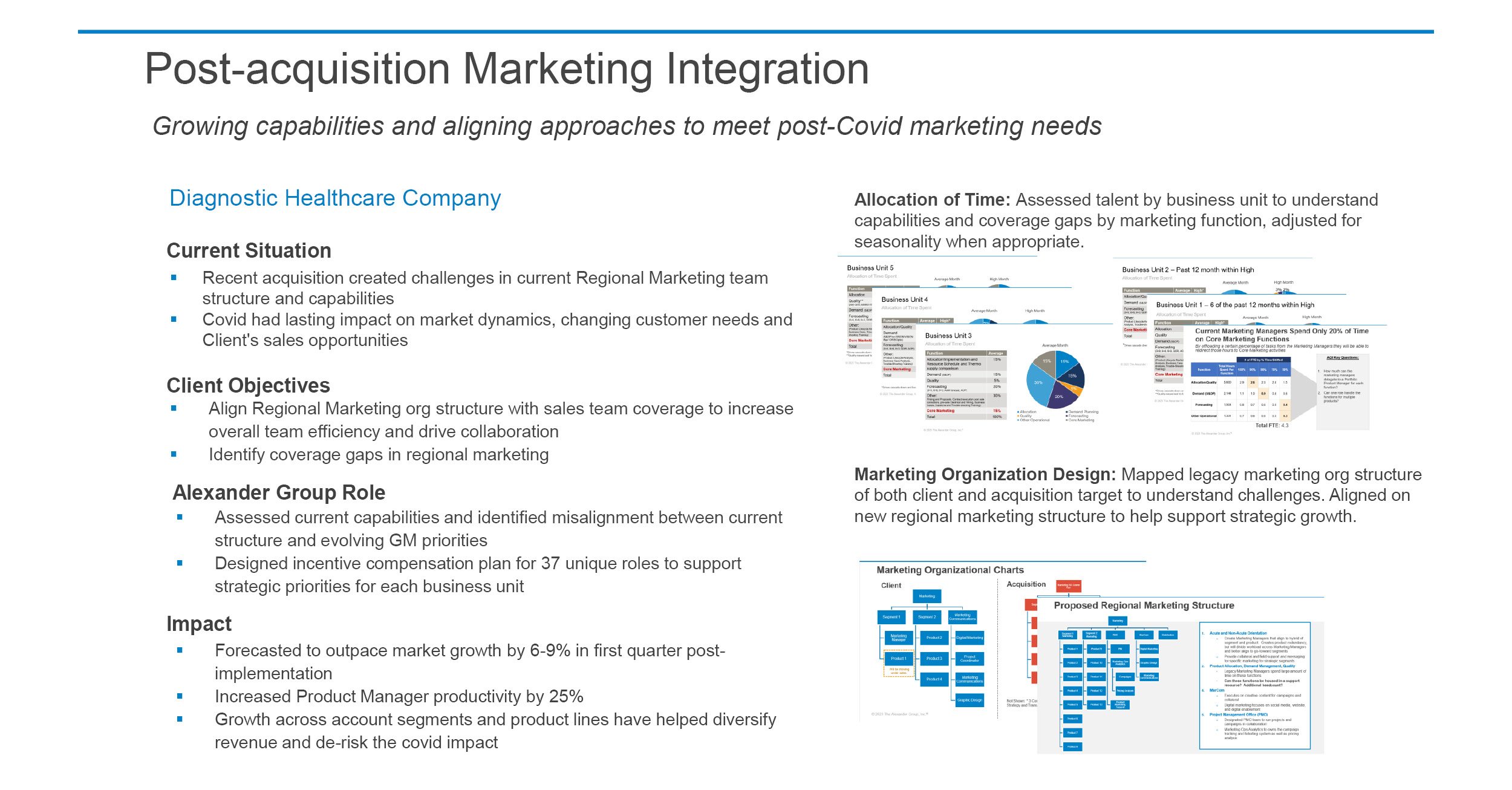
Explore how one organization addressed fragmented content, duplicative efforts and unclear “digital” ownership: