


Redesign Coverage to Close the Efficiency Gap
In a world where buyers expect specialized expertise, relevance and outcome-oriented interactions, the traditional sales pod is no longer viable. In response, leading commercial c-suite leaders are rebuilding coverage models to ensure talent is deployed deliberately and have interactions that are cost-effective:
- The Account Executive (AE) as Commercial Architect: AEs must function as strategic orchestrators, uncovering deep business pain, mapping political dynamics and qualifying rigorously before pulling in technical experts. Rather than just product explanation, the AE’s differentiation now lies in multi-threading, influence-building and commercial design.
- The High-Value Technical Overlay: Solutions engineers (SEs) are shifting away from generic demos toward tailored proof of concepts that validate architectural fit and business-critical workflows. AI-driven automation is removing low-value qualification tasks, enabling SEs to focus on the complex problem-solving that secures enterprise deals.
- Value Engineering for the Enterprise: In the enterprise segment, selling features is not a winning strategy. Dedicated value engineers (VEs) build ROI models, quantify efficiency gains and elevate the conversation to business impact. They help the buyer justify investment and accelerate CFO alignment.
- Product and Solutions Specialists: As portfolios expand, specialists offer functional depth that AEs cannot maintain alone. Their presence ensures technical credibility and precision throughout the cycle.
This is not a mandate to add headcount. Instead, it is a mandate to shift headcount. Overlay ratios must flex by segment and product readiness. Moving forward, focus human capacity on high-value motions that AI cannot replace.
Align Functions Around Measurable Value Realization
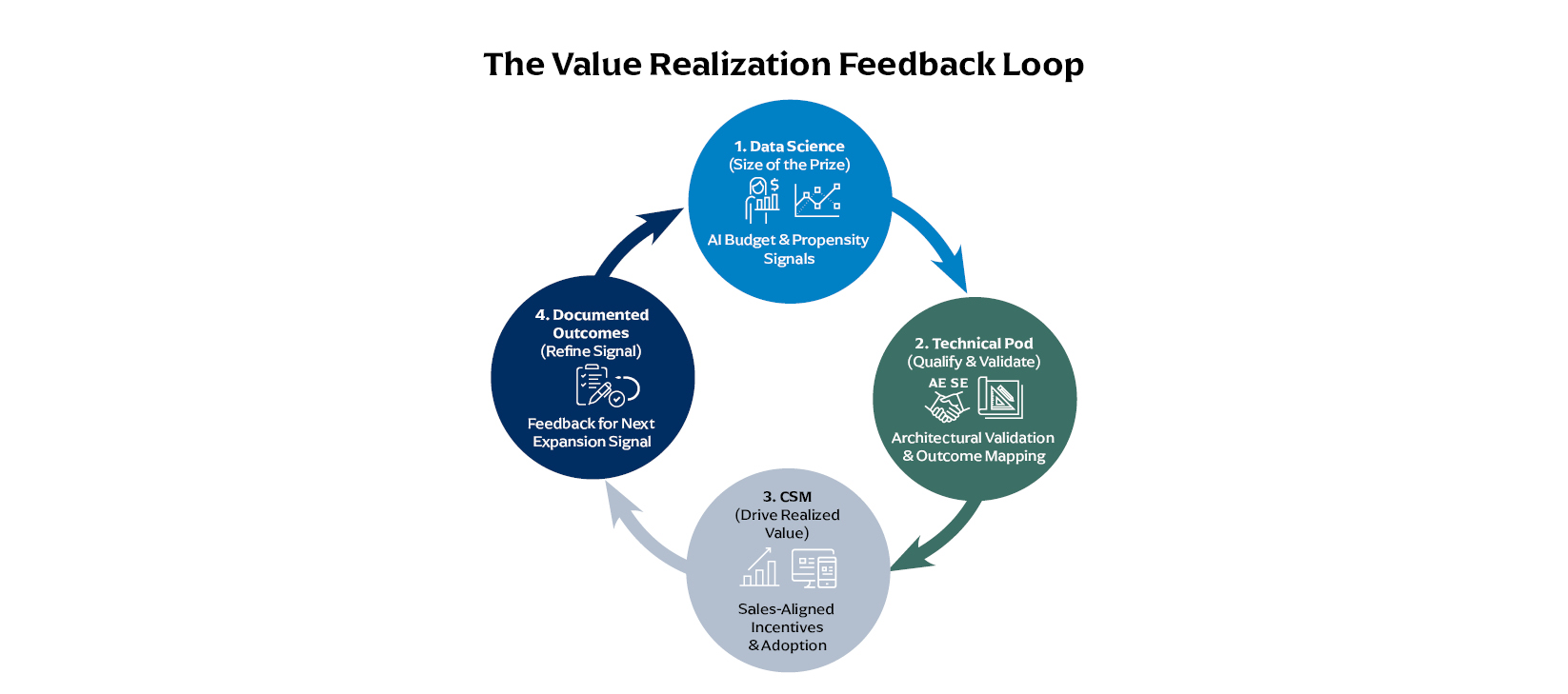
Adoption alone is no longer a meaningful metric. Leading companies achieve materially higher NRR and GRR by operationalizing value realization – not software usage – as the goal.
According to Alexander Group benchmarks, leading companies achieve 117% NRR and 95% GRR, compared to 105% and 89%, respectively, for average performers.
The commercial c-suite must bridge the gap between the sales and success functions through these key levers:
- Pre-Sales Value Mapping: Sales and customer success (including delivery roles such as forward-deployed engineers (FDE)) must collaborate before signature to define the value benchmarks the buyer expects to realize. This keeps everyone focused on the same outcomes from evaluation to expansion. It also eliminates the traditional “cold start” post-sales handoff.
- Outcome-Based Incentives: Forward-thinking commercial c-suite leaders are placing customer success on sales‑aligned compensation plans tied to realized value and expansion outcomes. This shifts focus from onboarding tasks to the ROI proof that buyers and especially CFOs now require before approving SaaS renewals.
By aligning sales and success around a shared value architecture, organizations accelerate time-to-value, strengthen renewal posture and expand more predictably.
Capture Enterprise AI Budgets Through Integrated Data Science
Enterprise AI budgets have matured into core operating expenditures, with LLM and automation investment expected to grow more than 70% year-over-year. The commercial c-suite, who operationalize data science within GTM, are capturing outsized portions of this spend:
- Opportunity Propensity Models: Identify accounts with the highest “Size of Prize” and conversion likelihood, enabling AEs to prioritize strategically rather than uniformly.
- Next Best Offer (NBO) Algorithms: Sequence cross-sell motions during renewal cycles using AI-powered intent signals to enable smarter, more predictable expansion.
- Predictive Churn Analytics: Leverage usage signals to surface risk earlier and trigger targeted interventions that protect the base.
Organizations deploying these models are seeing a measurable uplift in annual revenue performance and improved predictability across the funnel.