

A Massive Shift in Manager Activities
A significant share of what FLSMs do today will be AI-led within the next few years. In fact, Alexander Group estimates that up to 65% of historical FLSM activities could be performed autonomously by AI by 2028.¹
These will include:
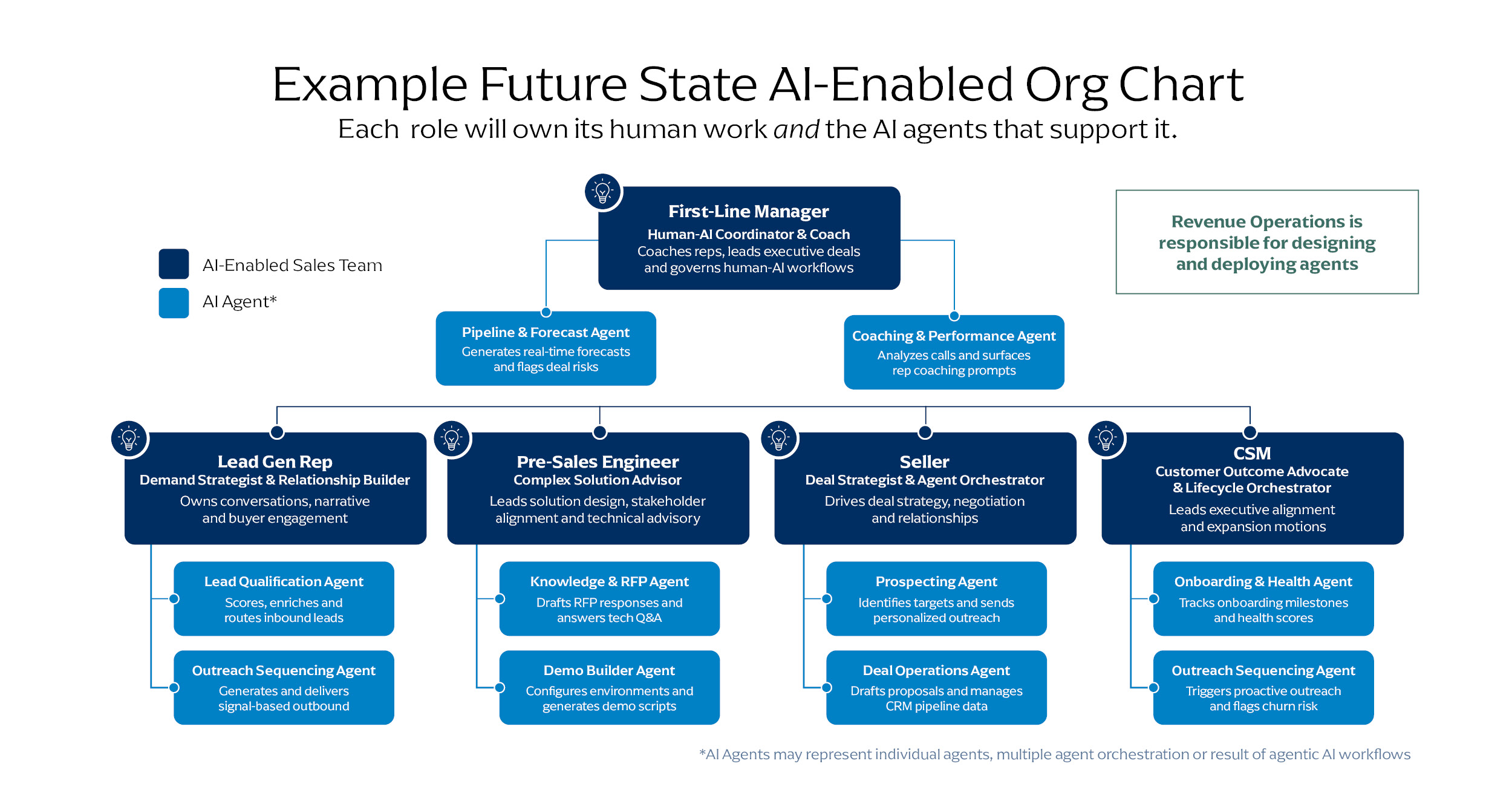
- Pipeline monitoring and forecasting: AI continuously analyzes deal signals to generate real-time forecasts and flag risks.
- Rep activity monitoring and reporting: AI captures activity data and auto-generates performance dashboards.
- Call analysis and coaching insights: AI processes call transcripts to surface actionable coaching prompts.
- Leadership performance reports: AI aggregates data and produces executive-ready summaries.
These aren’t peripheral tasks and represent the core operational backbone of the traditional FLSM role, which are the activities that have historically consumed much of a manager’s time. However, the role doesn’t shrink when AI absorbs this work. Instead, it fundamentally changes.
The First-Line Sales Manager as Human-AI Coordinator and Coach
As more activities move to AI, the first-line sales manager must evolve from activity manager to human-AI coordinator and coach—a fundamental repositioning that redefines the job.
Sales managers will be expected to oversee human and AI workflows, set standards for how AI tools are used across the team and calibrate decisions. When put into practice, these responsibilities play out across three dimensions.
1. Deeper, evidence-based coaching
AI makes coaching more scalable and more critical. When AI surfaces call insights, deal risk signals and rep-specific coaching prompts, managers can act on evidence rather than intuition. Managers can expand their influence across more deals without requiring direct involvement in every conversation, shifting value from being in the room to shaping how reps perform across every room.
With AI expanding seller capacity, the performance gains that matter most come from improving the middle of the team, accelerating skill development and reinforcing the right behaviors at scale. This is where CROs find the most untapped yield.
In most technology sales organizations, the top 20% of reps are largely self-sufficient, while the bottom 15% are on managed performance plans. It’s the middle 65% where coaching quality determines whether the sales organization hits plan. Here, AI-enabled managers can have a disproportionate impact.
2. Supporting complex deals and executive buyer/influencer engagement
As AI handles operational management, managers reclaim bandwidth to support reps on the work that demands human judgment: navigating ambiguity in enterprise deals, building executive relationships and orchestrating multi-threaded deal strategies. This is where manager involvement most directly impacts revenue outcomes and where AI can’t substitute for experience and relationship capital.
3. Governing human-AI workflows
Managing digital employees is emerging as a new leadership capability, and managers must now define roles, rules and escalation paths across both human and AI activities. As a skill set that didn’t exist two years ago, this now includes building and managing personal AI agents.
For example, managers can utilize an agent that analyzes deals, flags roadblocks and suggests actions for the manager’s review and interpretation. The manager can use this intelligence to have more meaningful discussions with AEs and help make more informed decisions to push opportunities forward.
Another AI agent use case includes taking output from a coaching agent that analyzes calls and surfaces rep-specific coaching prompts. With this, managers are enabled to coach at scale without being on every call.
This pattern extends beyond the FLSM. In the future-state GTM organization, each customer-facing role will own both its core strategic work and the AI agents that support it. The FLSM sits at the center of this model by coordinating human and AI performance across the team, with Revenue Operations responsible for designing and deploying the broader agent ecosystem.